How Many Hours Do Air Conditioners Run? A Practical Guide
Understand how many hours air conditioners typically run daily, the factors that influence runtime, and practical tips to optimize comfort and efficiency. Expert guidance from Air Conditioner Service helps homeowners estimate and manage cooling hours.


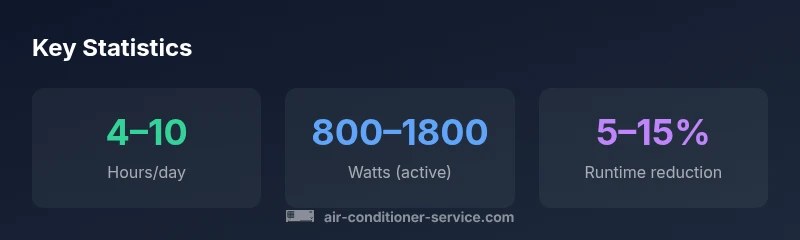
Air conditioners typically run several hours per day during hot weather, with most homes averaging about 4 to 10 hours of cooling depending on climate, insulation, occupancy, and thermostat settings. In very hot regions, units may operate longer, while milder climates require less runtime. Air Conditioner Service notes that runtime is climate- and load-dependent, not a fixed figure.
How many hours does an air conditioner typically run in a day?
During peak cooling season, most homes see meaningful runtime on most days, but the exact hours depend on several factors. In moderate climates, a typical daily run might land in the 4–6 hour range, while in hotter regions it can extend toward 8–12 hours or more. This variability isn’t a flaw in the system—it reflects how much cooling load the house experiences and how the thermostat is programmed. The Air Conditioner Service team often finds that once residents set a stable schedule and maintain basic efficiency, the observed daily runtime tends to converge within a practical range rather than fluctuating wildly. Consider tracking your own daily run-time for a week to establish a baseline that accounts for your home’s unique heat gain and occupancy patterns.
Factors that influence runtime
Runtime is shaped by climate, home envelope, and equipment behavior. Key drivers include:
- Outdoor temperature and humidity: Higher heat and humidity increase cooling demand.
- Insulation and air sealing: Poor insulation or gaps raise cooling load and run time.
- Thermostat setpoint: Lowering the temperature or keeping it very close to outdoor temps increases run time.
- Internal heat gains: Occupants, appliances, lighting, and electronics add to the load.
- System size and efficiency: Oversized or undersized units, and equipment with lower SEER ratings, affect how long the compressor runs.
- Ventilation and fans: Proper use of fans and ducted air can reduce compressor runtime.
Air Conditioner Service notes that tuning these factors can reduce inefficient cycles and improve comfort without sacrificing cooling performance.
Climate differences: hot vs temperate regions
In hot, sun-soaked climates, the AC runs longer to maintain comfortable indoor conditions. In temperate or milder regions, cooling may be intermittent or seasonal. The same unit can show very different runtimes across neighborhoods due to shading, window orientation, and occupancy. Smart thermostats can adapt to these patterns, learning when to run and when to idle, which often reduces unnecessary hours while preserving comfort.
How to estimate runtime for your home
A practical approach blends simple math with real-world observation:
- Set a comfortable indoor target (for example, 72–74°F) and a reasonable schedule.
- Use a programmable or smart thermostat to implement that schedule and monitor daily run time.
- If you want a rough estimate, multiply the compressor on-time per hour by the unit’s wattage and apply your electricity rate to approximate daily energy costs. This will vary with efficiency and climate, but it gives a usable baseline for planning.
- Repeat this over a week: weekdays vs weekends, and consider any shifts in occupancy or heat sources. Air Conditioner Service recommends documenting at least seven days to capture variations.
Thermostat settings and their impact on runtime
Small changes to setpoints can substantially change runtime. For example, increasing the cooling setpoint by 2–3°F can significantly reduce daily run time while maintaining comfort for most people. Program a schedule that matches your occupancy or implement adaptive cooling features if your thermostat supports them. Consistency helps the system run more efficiently by avoiding frequent short cycles that waste energy and wear components.
Efficiency, size, and the lesson of ‘bigger isn’t always better’
A larger air conditioner doesn’t always mean more efficient cooling. In fact, an oversized unit can short-cycle, increasing wear and reducing comfort. A properly sized system with a high SEER rating often achieves the desired indoor conditions with shorter, more efficient runs. When selecting equipment, balance cooling needs, noise considerations, and energy efficiency. Regular maintenance keeps runtime predictable and efficient.
Maintenance moves runtime toward predictability
Filter cleaning, duct inspection, and refrigerant checks help the system move air efficiently and reduce wasted runtime. A dirty filter can force the system to work longer, while leaky ducts can rob you of cooling without the same perceived comfort. Schedule seasonal checkups and address obvious air leaks or insulation gaps promptly. Air Conditioner Service recommends a quarterly quick check for most homes to keep runtime aligned with actual cooling needs.
Real-world scenarios: apartments vs multi-story homes
A small apartment with good insulation and an efficient unit may require modest runtime, while a sun-exposed two-story home in a hot climate can demand significantly more. In both cases, fine-tuning thermostat schedules, sealing gaps, and ensuring proper refrigerant charge are the levers that bring runtime into a practical, predictable range. Use the data you collect from your own home to refine energy plans and expectations.
Estimated daily cooling hours by home size
| Scenario | Estimated Daily Cooling Hours | Notes |
|---|---|---|
| Small apartment | 4–6 | Climate-driven; good insulation |
| Mid-size home | 6–9 | Average layout; mixed sun exposure |
| Large house | 8–12 | Hot climate; higher heat load |
Common Questions
How many hours should an air conditioner run per day?
There isn’t a single universal number. Most homes run 4–10 hours daily during peak cooling, with hotter climates typically requiring more. Use a baseline based on your local climate and then adjust for comfort and energy costs.
Most homes run about 4 to 10 hours a day when it’s hot, but it varies by climate and how you set the thermostat.
Does running an AC continuously damage it?
Continuous running doesn’t necessarily damage the system if it’s properly maintained and charged. Short cycling or running a unit well beyond its design range can cause wear and inefficiency. Regular maintenance helps prevent issues.
Running continuously isn’t inherently harmful if the unit is well maintained; poor maintenance can lead to wear and higher costs.
How can I estimate runtime for my home?
Start with a baseline: set comfortable temperatures, program a schedule, and monitor daily run-time for a week. Use this data to project monthly consumption and adjust for seasonal changes.
Set a schedule, monitor run-time for a week, and use that data to estimate monthly usage.
Can thermostat settings affect runtime?
Yes. Lowering the setpoint or keeping it near outdoor temperatures increases runtime. Increasing the setpoint by a couple of degrees can noticeably reduce hours while preserving comfort for most homes.
Yes—thermostat settings can cut or increase run-time significantly.
What other factors influence runtime besides climate?
House tightness, insulation, shade and sun exposure, occupancy patterns, and equipment efficiency all influence how many hours the system runs daily.
Insulation, shade, and efficiency all shape how long your AC runs.
When should I call a professional about runtime concerns?
If you notice persistent short cycling, unusually long runtimes without comfort, or rising energy costs, a professional check can verify refrigerant levels, airflow, and system sizing.
Call a pro if cycles seem off or energy costs rise unexpectedly.
“Runtime should be viewed in the context of comfort and efficiency. By aligning cooling hours with actual heat load and using smart controls, you can achieve consistent results without wasted cycles.”
The Essentials
- Track your own runtime for accuracy
- Tune thermostat settings to cut unnecessary hours
- Improve insulation to reduce load
- Size and efficiency matter more than intuition