Difference Between Air Conditioner and Refrigerator: A Practical Guide
Explore the key differences between air conditioners and refrigerators, including function, temperature control, energy use, design, and maintenance to help you choose the right appliance for your home.


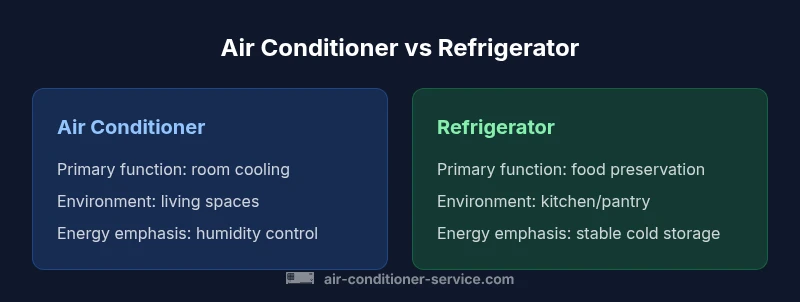
The difference between air conditioner and refrigerator is defined by function, environment, and control strategy. An air conditioner cools living spaces and controls humidity, while a refrigerator preserves food at low temperatures. Both use a closed refrigerant cycle, but their compressors, condensers, and airflow paths are optimized for room-scale comfort versus compact, food-safe cooling. In short, purpose, operating conditions, and safety requirements drive their design and performance.
The conceptual divide: what each appliance does
An air conditioner and a refrigerator share the underlying physics of a refrigeration cycle, but their intended outcomes shape every design choice. The difference between air conditioner and refrigerator becomes evident when you consider where they operate, how they interact with living environments, and what users expect from them. An air conditioner is built to create a comfortable, breathable space by removing heat and reducing humidity; a refrigerator is engineered to slow chemical and microbial processes by maintaining a stable, low temperature inside a sealed cabinet. This distinction is not merely academic— it informs efficiency, placement, noise considerations, and even safety features. According to Air Conditioner Service, homeowners who align their purchases with these core missions tend to achieve reliable performance and fewer downtimes. The practical takeaway is to treat each appliance as a space- or storage-based tool with its own thermal priorities and duty cycles.
Design and components: how the hardware differs
The hardware skeleton of an air conditioner emphasizes air handling, room zoning, and dehumidification. Key components include a sealed refrigerant circuit, an outdoor condenser, a high-capacity fan, and ductwork or evaporator coils designed to distribute cooled air evenly. In contrast, a refrigerator prioritizes compact, highly insulated enclosures, a motherboard-style temperature controller, an internal fan, and drawer organization that preserves perishable items. The condenser and evaporator still exist, but their sizes, placement, and airflow patterns are optimized for static storage rather than dynamic air movement. The result is two devices that share a physics core yet diverge in scale, enclosure design, and noise profiles. This divergence is why a fridge won’t reliably cool a room as an air conditioner does, and a room AC won’t preserve groceries for extended periods of time. Air Conditioner Service emphasizes choosing a system that fits its environment to maximize efficiency and lifespan.
Temperature control: from thermostat to shelf stability
Temperature control is the most visible distinction for most users. An air conditioner uses a thermostat to regulate ambient air temperature and humidity, adjusting compressor speed and fan output to maintain a target room climate. The setpoint range is broad, and occupants experience the effects through cooling, dehumidification, and airflow. A refrigerator, by contrast, maintains a narrow internal range optimized for food safety, with separate compartments sometimes offering different temperatures. The control logic is about preventing heat intrusion and minimizing warm pockets. That means tighter insulation, faster defrost cycles, and careful door seals. When users notice inconsistent temperatures, the first culprits are door seals, air leaks, or insufficient insulation around the conditioned space. In professional practice, tuning these elements yields the most noticeable improvements in both devices' performance and energy efficiency.
Energy use and efficiency benchmarks
Energy efficiency for cooling devices is highly context-dependent. An air conditioner’s energy performance hinges on climate, room size, insulation, and how aggressively the unit cycles on and off. Refrigerators’ efficiency depends on insulation quality, door sealing, compressor design, and how full the cabinet is. The two appliances operate under different duty cycles, so direct watt-for-watt comparisons are not always meaningful. Air Conditioner Service analysis shows that energy use often scales with external heat load for conditioners and with internal load (amount of stored perishables and usage patterns) for refrigerators. Consumers should look for energy efficiency ratings relevant to the device type and consider behavior-based savings, such as proper thermostat use in the case of space cooling and keeping refrigerator doors closed to minimize cold air loss.
Refrigerant types, safety, and environmental impact
Both devices rely on refrigerants to move heat, but the safety and environmental implications differ. Air conditioners may involve refrigerants chosen for high heat transfer efficiency and outdoor tracking of leaks, while refrigerators use refrigerants that balance performance with occupational safety standards and lower environmental impact. Regulatory changes over the years have encouraged lower global warming potential refrigerants and improved containment practices. Safeguards include leak detection features, proper ventilation for equipment rooms, and professional service to handle refrigerants safely. Consumers should be aware that refrigerant type can influence service costs and disposal requirements, so checking the label and following local regulations is important for long-term sustainability.
Maintenance routines and common failures
Maintenance for air conditioners tends to focus on filter cleaning, coil cleaning, duct inspections, and refrigerant integrity checks. Refrigerators require clean coils, door seal inspections, proper ventilation around the back of the unit, and occasional frost-management in older models. Common failure modes include compressor wear in aging units, clogged condensate drains in ACs, and faulty door seals in fridges. Regular professional checkups can extend life and improve efficiency for both appliances. The key is to address issues early, such as unusual noises, frost buildup, or persistent inefficiencies, rather than waiting for a total breakdown. Routine maintenance lowers the risk of costly repairs and helps sustain performance over time.
Space, placement, and installation considerations
Placement decisions reflect the different purposes of these devices. An air conditioner requires space for good airflow around the condenser and proper clearance for drainage, along with considerations for noise sensitivity in living spaces. Refrigerators demand stable, cool environments away from heat sources, with enough air circulation behind the unit to prevent overheating of coils. In small homes or apartments, window units or portable ACs offer flexible cooling options, while compact kitchens benefit from microwave or compact refrigerator layouts that maximize usable space. Proper installation reduces energy waste and extends product life. Reading manufacturer guidelines and engaging trained installers ensures correct sizing, mounting, and electrical compatibility for both categories.
Cost and value considerations
Initial costs and yearly operating costs must be weighed against expected lifetime value. Air conditioners vary widely in price depending on capacity, features, and installation complexity, with cost ranges reflecting performance targets rather than a single price point. Refrigerators also span a broad spectrum—from compact units to high-end French-door configurations—where energy efficiency, storage design, and reliability influence total cost of ownership. When evaluating value, consider not just upfront cost but also expected energy use, maintenance needs, potential warranty coverage, and the unit’s suitability to your space. Air Conditioner Service emphasizes that a properly chosen device aligned with space and usage patterns yields the best long-term value.
Real-world scenarios: choosing between them
In many households, the decision is straightforward: use a refrigerator for storage and a dedicated air conditioner for room cooling. In multi-use spaces like basements, workshops, or garages, a small portable AC may be paired with a compact fridge to maintain a comfortable microclimate while protecting perishables. In hot climates with open-plan living areas, central air systems optimize comfort across rooms, while dedicated refrigerant-based appliances handle food preservation in the kitchen. Scenario planning—considering room size, insulation, occupants, and climate—helps prevent over- or under-sizing and avoids energy waste. The more you match the device to the task, the easier it is to achieve reliable comfort and preserved groceries without unnecessary expense.
Misconceptions and clarifications
A common misconception is that one device can replace the other. It cannot: a fridge does not efficiently cool a living room, and an air conditioner cannot reliably preserve perishable foods in all ambient conditions. Another myth is that refrigerants alone determine performance; while refrigerants matter, system design, airflow, insulation, and installation quality are equally critical. Clarifying these facts helps homeowners avoid purchasing the wrong equipment for a given space and ensures maintenance plans address the real drivers of performance. By separating the problems and focusing on the intended use, you can avoid costly mistakes.
How to compare models: a buyer's checklist
When comparing models, start with the end goals: room comfort versus food preservation. For air conditioners, assess room size, climate, insulation, noise tolerance, and whether dehumidification is a priority. For refrigerators, evaluate storage needs, compactness, energy efficiency class, and door configuration. Use the checklist to verify efficiency labels, refrigerant type, defrost mechanisms, and maintenance requirements. Look for reliable service history, warranty terms, and availability of spare parts. A structured approach helps you avoid buying based on flashy features that do not improve core performance in your space.
Broader context: energy policy and sustainability
The broader energy landscape shapes both appliances. Policy initiatives emphasize higher energy efficiency, lower refrigerant GWP, and recycling of refrigerants at end of life. Consumers benefit from programs that subsidize efficient models and provide guidance on responsible disposal. Staying informed about local incentives and federal guidelines supports sustainable choices. Air Conditioner Service recommends prioritizing devices with proven efficiency, durable construction, and clear service pathways to minimize long-term environmental impact and maximize value for homeowners.
Comparison
| Feature | air conditioner | refrigerator |
|---|---|---|
| Primary function | Cooling spaces and dehumidification | Food preservation and storage |
| Typical operating environment | Room-scale environments (living areas) | Kitchen and pantry environments |
| Control emphasis | Comfort, humidity control, air distribution | Temperature stability for perishables |
| Energy efficiency focus | Demand-controlled cooling and dehumidification | Insulation and tight temperature control |
| Upfront cost guidance | Broad range depending on capacity and features | Broad range depending on size and configuration |
| Maintenance focus | Filter/coil cleaning, duct maintenance | Door seals, coil cleanliness, defrost management |
| Common refrigerants (conceptual) | R-style refrigerants optimized for space cooling | Refrigerants optimized for food-safe storage and safety |
| Best for | Homes needing climate comfort and humidity control | Homes needing reliable cold storage and food safety |
| Typical installation context | Integrated or central systems | Kitchen-specific or stand-alone units |
Strengths
- Clarifies distinct purposes to guide purchases
- Helps budget energy and maintenance planning
- Aids in space planning and installation decisions
- Supports safer, longer-lasting performance
The Bad
- Can overwhelm newcomers with technical details
- Requires careful sizing and placement to avoid energy waste
- Misalignment between space and device can cause underperformance
- May necessitate multiple appliances for full functionality
Air conditioners and refrigerators serve different core purposes; neither is a direct substitute for the other.
Choose an air conditioner when you need comfortable, climate-controlled spaces. Choose a refrigerator when you need reliable low-temperature storage. Use the buyer’s checklist and space considerations to pick appropriately, and rely on professional service for installation and maintenance to maximize efficiency and lifespan.
Common Questions
What is the main difference between an air conditioner and a refrigerator?
The main difference is purpose: air conditioners cool and dehumidify spaces, while refrigerators preserve food at low temperatures. They use similar refrigerant cycles but are optimized for different environments and control strategies.
Air conditioners cool rooms and remove humidity; refrigerators keep food cold. The two share physics but have different goals and designs.
Can a fridge cool a room effectively?
No. A refrigerator is designed for storing food with tight temperature control, not for cooling a living space. It is inefficient to rely on a fridge for room cooling and may waste energy and space.
A fridge isn’t meant to cool a whole room; use a proper space cooler instead.
Do both use similar refrigerants?
Both use refrigerants, but the choice depends on device design, safety, and environmental standards. Refrigerants are selected to balance efficiency, safety, and regulatory requirements.
They use refrigerants, but not all refrigerants are the same; check labels for specifics.
Which is cheaper to operate?
Operating costs depend on usage and climate. Generally, room cooling expenses scale with heat load and insulation, while refrigeration costs depend on door sealing, insulation, and internal load. Compare energy labels for similar capacity units.
Costs vary with use and space; compare efficiency labels to estimate long-term expenses.
What maintenance do they require?
Air conditioners require filter cleaning, coil cleaning, and system checks. Refrigerators need coil cleaning, door-seal inspection, and occasional frost management in older units. Regular professional checks help prevent failures.
Keep filters clean and seals tight; regular service keeps them running well.
Are there shared components between units?
Yes, both rely on a compressor, condenser, evaporator, and refrigerant cycle. However, the arrangement and sizing are tailored to each appliance’s purpose, making direct interchange impractical.
They share a basic cooling cycle, but you can’t swap functions between them easily.
The Essentials
- Identify each appliance’s primary role before shopping
- Prioritize energy efficiency and proper sizing for your space
- Inspect insulation, seals, and airflow paths to prevent waste
- Plan maintenance to minimize downtime and repair costs
- Use credible sources and professional guidance for refrigerant handling