Difference Between Air Conditioner and Inverter: An Analytical Comparison
Explore the key differences between traditional air conditioners and inverter models, covering efficiency, comfort, costs, and practical buying tips for homeowners.


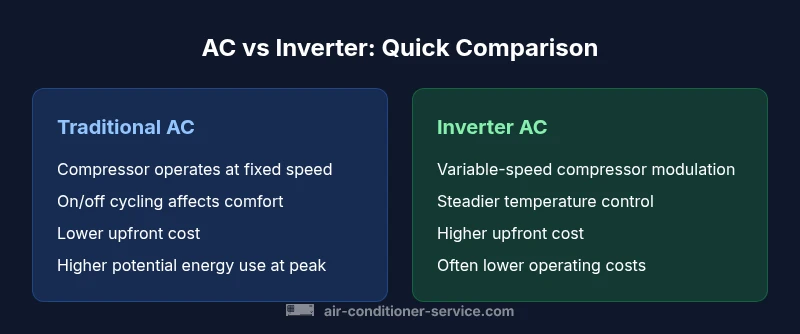
The difference between air conditioner and inverter centers on how the compressor runs. Traditional AC uses a fixed-speed compressor, while inverter models modulate speed for continuous cooling and energy efficiency. According to Air Conditioner Service, this key distinction affects comfort, noise, and running costs, especially in varying temperatures. Understanding this helps homeowners select equipment that matches climate, occupancy patterns, and budget constraints.
Understanding the difference between air conditioner and inverter
The difference between air conditioner and inverter systems is not merely about labels but about how cooling capacity is produced and controlled. A conventional fixed-speed air conditioner switches the compressor on at full capacity and then off when the desired temperature is reached. An inverter air conditioner, by contrast, uses a variable-speed compressor and electronic controls to modulate cooling output continuously. This difference affects how quickly space cools, how stable the temperature feels, and how electricity is used over the course of a typical day. According to Air Conditioner Service, the core distinction lies in modulation: fixed-speed units cycle on and off, while inverter units adapt. This subtle shift has practical consequences for comfort, energy bills, and equipment wear. Understanding it helps homeowners choose equipment that matches climate, occupancy patterns, and the size of the space being cooled, rather than relying on general assumptions about better versus less capable units.
How fixed speed versus variable speed compressors operate
Traditional fixed-speed compressors run at 100 percent capacity or shut down completely. They deliver cooling in on/off bursts, which can create temperature swings and occasional peak electricity use. Inverter compressors respond to sensors and adjust speed smoothly, providing partial loads that align with real-time cooling demand. The result is more uniform temperatures, fewer abrupt changes, and often lower energy consumption over a typical day. For homeowners, the choice hinges on climate, daily occupancy, and how sensitive the indoor environment is to temperature fluctuations. Air Conditioner Service notes that the real-world impact comes from modulation quality, compressor design, and the control system surrounding the unit.
Energy efficiency metrics explained
Energy efficiency is measured in several ways, with SEER and COP among the most common in the United States and many other regions. A traditional unit may show decent peak efficiency but struggles at partial loads, whereas inverter models maintain higher efficiency across a broader range of conditions due to continuous modulation. EER and IPLV also provide snapshots of performance under specific test conditions. The key takeaway is that efficiency metrics often improve when cooling needs are varied rather than constant. Air Conditioner Service emphasizes looking at how a system performs under real daily conditions rather than relying solely on peak test results. This helps homeowners estimate true operating costs over a typical cooling season.
Temperature control dynamics and comfort
Inverter systems maintain indoor temperatures with far less fluctuation by adjusting compressor speed to meet demand. Fixed-speed systems heat or cool in discrete cycles, which can leave small gaps in temperature regulation during peak heat or rapid changes in outdoor conditions. The result is that inverter units tend to feel more comfortable, especially in spaces with frequent access or variable occupancy. For energy-conscious households, this translates into a steadier climate with potentially fewer thermostat adjustments. The difference may seem small at first, but it compounds over days and weeks, influencing perceived comfort and energy bills.
Noise and wear: what to expect
Fixed-speed compressors produce a familiar cycling sound that can surprise occupants during hot spells. Inverter compressors run at slower speeds most of the time, which generally reduces noise levels and minimizes vibration. This quieter operation can contribute to a calmer living environment, particularly in bedrooms or open-plan living areas. In terms of wear, the smoother modulation of inverter systems reduces the on/off stress on motors and electrical components, potentially extending lifespan when maintenance is timely and appropriate. However, the added electronics in inverter units can present more complex repair needs if failures occur.
Cost considerations: upfront investment vs long-term savings
Upfront costs for inverter air conditioners are typically higher than traditional fixed-speed units. The premium reflects more sophisticated compressors, controls, and installation requirements. Over time, however, inverter systems can reduce operating expenses through better modulation, especially in climates with variable temperatures or frequent partial-load cooling. To determine value, homeowners should estimate monthly electricity usage under typical conditions, then weigh that against initial price differences and available warranties. Air Conditioner Service notes that the break-even point depends on climate, usage patterns, and maintenance quality.
Climate suitability and usage patterns
Inverter air conditioners often excel in climates with frequent temperature swings, high humidity, or irregular occupancy. In steady, mild climates, a fixed-speed unit may meet needs at a lower upfront cost, with energy savings largely realized through efficient operation during milder days. The practicality of a model also depends on installation quality, thermostat placement, and indoor air quality considerations. When evaluating products, homeowners should consider their typical daily routine, whether spaces are occupied irregularly, and how often cooling is needed during shoulder seasons. Air Conditioner Service emphasizes matching the system to actual usage rather than chasing generic efficiency claims.
Maintenance, serviceability, and warranty considerations
Maintenance requirements for inverter and fixed-speed units share many fundamentals: filter cleaning, coil care, and refrigerant integrity top the list. Inverter systems may require attention to sensors, inverter boards, and refrigerant lines, which can affect serviceability in some regions. Availability of skilled technicians is a real factor; not all contractors have equal expertise with variable-speed technology. Warranty terms often reflect component complexity, so it is wise to read coverage carefully and retain service records. Regular professional inspections help ensure modulation remains efficient and reliable over time.
Myths and misconceptions about inverter technology
A common myth is that inverter air conditioners always outperform fixed-speed models in every situation. In reality, performance hinges on proper sizing, installation, and climate matching. Another misconception is that inverter units never shut off; while they modulate, they still cycle under certain conditions such as very high outdoor temperatures or system alarms. Clarifying these points helps homeowners avoid overpaying for features they do not need while still gaining the comfort and efficiency benefits of proper modulation.
Reading specifications: key terms to compare
When evaluating options, look beyond the headline efficiency figure. Check the system’s performance at partial loads, the inverter type (PWM vs hysteresis), compressor design, refrigerant charge, and the quality of the outdoor unit. A well-matched system also depends on ductwork or zoning, thermostat strategy, and insulation. This approach aligns with practical decision making rather than chasing the best efficiency rating in isolation. Air Conditioner Service recommends compiling a comparison sheet that includes climate, usage, energy costs, and maintenance expectations to inform a robust decision.
Comparison
| Feature | Traditional AC (fixed-speed) | Inverter AC (variable-speed) |
|---|---|---|
| Compressor operation | Fixed on/off cycling | Variable-speed modulation |
| Cooling stability | More temperature swings | Steady temperature under varying loads |
| Energy efficiency | Lower across partial loads | Higher across partial/load ranges |
| Upfront cost | Lower upfront cost | Higher upfront cost |
| Operating costs | Potentially higher during long cycles | Often lower due to modulation |
| Maintenance | Simpler serviceability | Slightly more complex electronics |
| Best for | Budget-focused or fixed usage | Homes with variable heat and long cooling periods |
Strengths
- Potential for noticeable energy savings with proper use
- Enhanced temperature control and comfort through modulation
- Lower operating costs under variable loads over time
- Better humidity management in certain models
The Bad
- Higher upfront purchase price
- More complex technology may require specialized service
- Availability of skilled installers varies by region
Inverter AC generally wins on energy efficiency and comfort, with a higher upfront cost.
If you prioritize steady temperatures and lower energy bills, inverter models are typically the better long-term choice. If upfront budget is the primary constraint, a traditional fixed-speed unit can suffice, but expect higher operating costs over time.
Common Questions
What is an inverter in an air conditioner, and how does it work?
An inverter air conditioner uses a variable-speed compressor and electronic controls to adjust cooling output. This modulation maintains steadier temperatures and can improve energy efficiency compared with fixed-speed systems. The inverter adjusts power in response to room conditions rather than simply turning on and off.
An inverter AC drops and raises its cooling speed to keep a steady temperature, which helps save energy and reduce temperature swings.
Is inverter air conditioning always more energy-efficient?
Inverter models tend to be more energy-efficient especially at partial loads, but actual savings depend on climate, usage patterns, and installation. A poorly sized system or bad ductwork can undermine efficiency. Compare real-world performance rather than just labeled efficiency.
Inverter often saves energy, but the actual savings depend on climate and proper installation.
Do inverter units cost more upfront than traditional units?
Yes, inverter air conditioners typically carry a higher upfront price due to the advanced compressor and control systems. The extra cost can be offset over time by lower operating costs, but the payback period varies by climate and usage.
They usually cost more up front, but can pay off with energy savings.
Are inverter units quieter than fixed-speed models?
In many cases inverter units operate more quietly because the compressor runs at lower speeds most of the time. However, noise can still come from other components like the outdoor fan or air handler, depending on design and installation.
Often quieter because the compressor runs more smoothly at variable speeds.
Will inverter AC perform well in very hot or very cold climates?
Inverter systems generally perform well in hot conditions due to modulation, but extreme cold can affect performance if heat pumps are used in heating mode. Always verify the model's rated operating range and climate suitability.
They work well in heat but check the climate range before buying.
What maintenance differences should I expect?
Maintenance is similar for both systems, but inverter units may require attention to sensors and inverter electronics. Regular professional checkups, filter cleaning, and refrigerant inspections remain essential for reliable operation.
Maintain filters, and have periodic checks for sensors and electronics.
The Essentials
- Evaluate compressor type to match climate and usage
- Consider upfront cost against long-term energy savings
- Prioritize proper sizing and installation for true efficiency
- Check for service availability and warranty terms