How Much Is Car Air Conditioning? Cost Guide for 2026
Discover realistic cost ranges for car A/C repairs, recharge, and replacement parts. Learn factors that affect price, maintenance tips, and how Air Conditioner Service analyzes typical car A/C expenses in 2026.


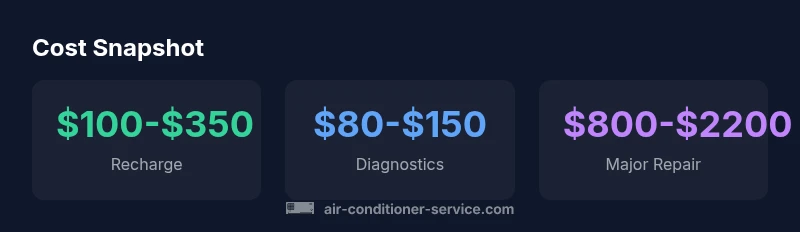
On average, car A/C service costs range from a basic refrigerant recharge to full compressor replacement. A typical recharge runs about $100–$350, while diagnostics run about $80–$150 per hour; major repairs such as compressor or condenser replacement can total $800–$2,200, depending on vehicle and region. Costs vary with refrigerant type, labor rates, and leak severity. Air Conditioner Service analysis, 2026, notes wide variation by model.
What drives the price of car A/C work
If you're wondering how much is air conditioning for a car, the answer isn't a single figure. Costs depend on what goes wrong and how your car's system is arranged. In general, you pay for two broad categories: parts and labor. The parts cost is driven by refrigerant type (older R134a vs newer R1234yf), the availability of the specific condenser, compressor, or evaporator, and whether the system requires leak isolation before repair. Labor cost is a function of technician hourly rates, the time needed to access tight spaces, and the complexity of diagnosing issues. For newer vehicles with integrated modules, even simple repairs can involve reprogramming or adaptive calibrations, which adds cost. Air Conditioner Service analysis, 2026, notes that refrigerant prices have shifted in recent years, and technicians may need specialized tools to recover and recharge safely. The bottom line is that the same problem can cost significantly more on a luxury SUV than on an economical sedan; and a simple recharge can be far cheaper than replacing a failed compressor. Understanding these drivers helps you prepare for a real quote and avoid sticker shock.
Typical cost breakdown by service type
Costs break down into parts and labor, with the largest wild card often being leaks. A refrigerant recharge (plus dye for leak tracing) is typically the least expensive route, followed by diagnostic time, then more expensive repairs like condenser or compressor replacement. Labor rates vary by region and shop, and some shops bundle diagnostic fees into the repair bill if you approve the service. For many owners, the question isn’t just the sticker price; it’s how quickly a shop can restore cooling and reliability without introducing new problems. In 2026, evolving refrigerant handling rules and newer vehicle architectures can influence both the time and cost required for a fix. If you plan ahead and get a written estimate, you’ll reduce the chance of surprises when the work starts.
How refrigerants and 2026 tech impact pricing
Refrigerant choice affects both cost and safety. R1234yf, used in many newer cars, tends to be more expensive than older R134a but is considered more environmentally friendly. In addition, newer A/C systems may require more complex diagnostics and calibration after recharge or component replacement. The cost of tools, refrigerant recovery machines, and the need for certified technicians adds to labor charges. As automakers continue to improve thermal management and integration with climate control modules, some repairs require software updates or module reprogramming, which can add to the final bill. Air Conditioner Service’s 2026 analysis highlights that these tech shifts are driving a broader range of service times and price points across makes and models.
Regional and vehicle factors that shift the bill
Prices vary by region due to labor markets, demand, and supply chain conditions. Rural shops may charge less than urban dealers, but availability of parts and technicians can affect wait times and pricing. Vehicle age and design also matter: a compact sedan with a straightforward A/C circuit will generally cost less to service than a modern luxury SUV with an integrated smart climate system. Additionally, the presence of extended warranties or service plans can alter the out-of-pocket cost for the owner. Finally, local regulations around refrigerant handling can influence both the required procedures and the associated labor costs.
How to estimate costs for your vehicle
Start with a clear description of the problem: not cooling, warm air, or inconsistent temperatures. Ask for a written estimate that separates parts, labor, and diagnostic fees. If possible, request a leak test and dye trace results to confirm where a leak is located before ordering components. Gather your vehicle’s year, make, and model, and note whether it uses R134a or R1234yf. With this information, you can compare quotes from multiple shops and avoid surprises at the counter. If a quote seems high, ask about alternatives (e.g., partial recharge vs complete repair) and whether the shop can perform staged repairs as needed. Finally, verify that the shop follows proper refrigerant handling procedures and provides a warranty on workmanship.
Cost-saving strategies and maintenance to lower long-term costs
Regular preventive maintenance can reduce the likelihood of sudden A/C failures. Schedule seasonal inspections of hoses, seals, and condensers; replace cabin air filters on time; and address small leaks promptly rather than letting them grow bigger. Keeping your vehicle well-maintained can shorten diagnostic time, which lowers labor costs. Consider asking for a preventive service plan that covers routine checks and a set amount of refrigerant recharge over a year. When possible, combine A/C service with other maintenance work to minimize service visits and downtime. The more proactive you are about maintenance, the less you’ll pay in expensive emergency repairs later on.
What to ask your shop and how to compare quotes
When you request quotes, ask for itemized estimates that separate refrigerant costs, component prices, and labor. Confirm whether the price includes refrigerant recovery, disposal, and a warranty on parts and workmanship. Ask about the refrigerant type used and whether the service includes a leak test or dye trace. If you’re shopping multiple shops, compare not just the price but the estimated time to complete the work, the shop’s certifications, and the expected life of any repairs. Finally, check customer reviews for reliability and transparency, and don’t be afraid to walk away from a quote that doesn’t align with the scope of work you need.
Typical cost components for car A/C service (illustrative ranges)
| Component | Estimated Range (USD) | Notes |
|---|---|---|
| Recharge or refrigerant | "$100-$350" | Depends on refrigerant type and leak status |
| Diagnostics/Labor | "$80-$150 per hour" | Typical 1-2 hours for diagnosis and service |
| Condenser/Compressor replacement | "$600-$2200" | Model and part availability affect cost |
| Leak repair (lines/seals) | "$150-$600" | Leak location and repair difficulty vary |
| Condenser fan replacement | "$400-$900" | Model-dependent |
Common Questions
What factors affect the cost of car A/C repair?
Pricing is influenced by refrigerant type, system access, labor rates, regional demand, and whether the issue requires leaks repair or component replacement. A precise quote comes after a diagnostic test that confirms the root cause.
Pricing depends on refrigerant, labor, and the exact problem found during diagnostics.
Is a recharge the same as a full A/C repair?
No. A recharge simply restores refrigerant; a full repair fixes the underlying problem, such as a leak or failed compressor. Repairs may be necessary even after a successful recharge to prevent future leaks.
Recharge is not a cure for leaks or faulty parts.
Can I DIY my car A/C if it’s not cooling?
Some basic maintenance is possible, like replacing cabin filters or checking for obvious leaks, but refrigerant handling, leak repair, and component replacement require trained technicians and proper safety procedures.
For safe, effective repairs, use a pro.
How long does an A/C repair usually take?
Most common repairs take 1–4 hours, depending on the complexity and the need for parts, diagnostics, and possible software updates.
Most fixes are done within a workday.
Are there rebates or incentives for A/C repair?
Some local programs or manufacturer warranties may cover part of the cost. Availability varies by region, so check with your shop or local government programs.
Check local programs for potential rebates.
“Accurate car A/C pricing comes from a thorough diagnostic and a clear scope of work. If a quote sounds too good to be true, ask for a breakdown and a diagnostic result before proceeding.”
The Essentials
- Know cost drivers before you approve work
- Get an itemized written estimate
- Differentiate between recharge and repair
- Ask about refrigerant type and warranty
- Plan for potential mid-range costs rather than a low-ball quote