What Size Air Conditioner for Bedroom: A Practical Sizing Guide
Learn how to determine the right air conditioner size for a bedroom, including BTU calculations, room factors, and efficiency tips. This guide provides step-by-step methods, practical examples, and pro tips for homeowners and renters.


If you’re asking what size air conditioner for bedroom fits best, start by calculating the required BTU based on room area, ceiling height, insulation, sun exposure, and occupant load. This quick guide outlines the formula, common rules of thumb, and practical steps for choosing a window unit, portable AC, or a small split-system. It also highlights when to call a pro for a professional load calculation. According to Air Conditioner Service, precise sizing saves energy and improves comfort.
Why size matters for bedroom comfort and energy efficiency
Bedroom cooling comfort hinges on selecting the right cooling capacity. In practice, rooms that are undersized heat up quickly and feel stuffy, while oversized units often short-cycle and struggle with humidity. According to Air Conditioner Service, proper sizing reduces energy waste and improves steady, comfortable cooling. This guide helps homeowners and renters determine the right size for a typical bedroom, considering area, ceiling height, insulation, sun exposure, and occupant load. We’ll walk you through the math, the practical steps, and real-world tips for choosing between window units, portable ACs, and mini-split systems. By following these steps, you’ll avoid oversizing or undersizing and keep energy bills under control.
Quick rule of thumb: BTU per square foot
A common starting point is 20 BTU per square foot for average rooms in moderate climates. For a bedroom, you can estimate BTU by multiplying the room’s area in square feet by 20, then adjusting for ceiling height, sun exposure, and occupancy. For example, a 12 × 12 ft room (144 sq ft) would start around 2,880 BTU, but most bedrooms benefit from a higher baseline when windows face south or there are many occupants. For practical purposes, window units typically range from 5,000 to 12,000 BTU, while larger bedrooms may require a small split-system in the 9,000–12,000 BTU range. Use this as a baseline and fine-tune with the adjustments below. (Note: specific climates and insulation can shift these figures.)
How to measure your bedroom space accurately
Start with length and width: measure the interior wall-to-wall distance in feet, then multiply to get square feet. Measure ceiling height; standard ceilings are 8 ft, but many bedrooms have higher ceilings that add to cooling load. Check for sun exposure by noting which walls receive direct sun during peak hours, and estimate the room’s occupancy: more people increases cooling load. Also record window area, since large windows or glass doors let in heat. Finally, note insulation quality, air leaks, and whether there’s a ceiling fan that can improve comfort without increasing AC size.
Other factors that influence the right size
- Sun exposure: South- or west-facing bedrooms can gain heat, raising cooling needs by roughly 10–20% depending on shading and glazing.
- Ceiling height: Taller rooms require more air volume to cool; for every extra foot of ceiling height, adjust BTU upward.
- Insulation and air leakage: Poor insulation or drafts increase the cooling load; seal gaps to avoid over-sizing.
- Occupant load: Each additional person adds heat; use the standard adjustment of about 600 BTU per person in the room when more than two occupants are present.
- Appliances and electronics: A TV, computer, or lamp can add heat; factor these into the calculation.
Sizing methods: calculators, charts, and when to call a pro
There are three practical ways to size a bedroom AC: 1) a BTU-by-square-foot estimate, 2) a room-by-room chart based on climate and insulation, and 3) a professional load calculation (Manual J). Many homeowners start with a simple formula (area × 20 BTU) and then apply adjustments above. Online calculators from reputable sources can guide you, but always verify with a pro if the result falls near a typical window unit size or if the room has unusual constraints. Air Conditioner Service analysis shows that real-world bedrooms often require adjustments beyond the basic rule of thumb. If you’re unsure, ask a licensed HVAC technician to run a Manual J or equivalent calculation.
Choosing the right type for your bedroom: window, portable, or split-system
- Window units: Affordable and easy to install; ideal for small bedrooms; typical ranges are 5,000–12,000 BTU. They’re best when you want a quick fix and don’t mind a unit in the window.
- Portable units: Flexible, no permanent installation; usually 8,000–14,000 BTU; useful if you rent or cannot modify a window. They’re less efficient and noisy but convenient.
- Split-system mini-split: Higher initial cost, but quiet operation and precise zoning; common sizes include 9,000–12,000 BTU for medium bedrooms. The right choice depends on budget, space, and whether you plan to cool more than one room.
A practical sizing checklist you can follow
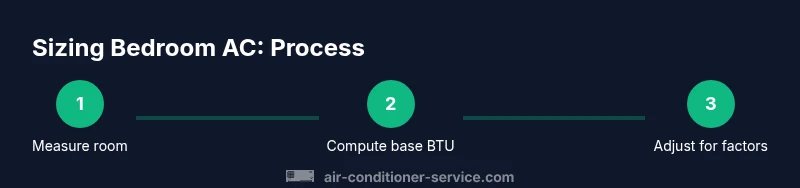
- Measure room area and ceiling height.
- Note sun exposure and insulation quality.
- Decide on window, portable, or split-system.
- Use the base BTU formula (area × 20 BTU) and adjust for the factors above.
- Pick a unit with a BTU within 10–15% of the target.
- Check efficiency ratings (SEER or EER) and energy star status.
- Test for comfort and humidity after installation.
Real-world example: sizing a typical small bedroom (12×12 ft)
Area: 144 sq ft. Base BTU: 2,880 BTU (144 × 20). Add adjustments: south-facing window +10%, occupant load +1 person +600 BTU, insulation average; total ~3,480 BTU. Since most window units start at 5,000 BTU, you’d typically install a 5,000–6,000 BTU unit for this room, and adjust if the ceiling is higher or the room receives intense sun. This example shows how the base rule of thumb guides your initial choice, while real-world factors shift the final BTU. Always aim for a unit that runs longer cycles to control humidity rather than a sharp, short cool.
Authority sources
- Energy.gov – Air Conditioning (general sizing guidance and energy-efficiency tips)
- EPA – Indoor air quality basics and cooling considerations
- NREL – Research and guidance on efficient cooling and homes
The Air Conditioner Service recommends using accurate BTU sizing to balance comfort and energy use across bedrooms of all sizes.
Tools & Materials
- Measuring tape(At least 15 ft (4.5 m) to measure room diagonals if needed)
- Calculator or smartphone app(For BTU calculations and adjustments)
- Notebook or digital device(Record measurements, notes on sun exposure, insulation, and occupants)
- BTU sizing chart or online calculator(Use as baseline; verify with a pro if results are near a boundary size)
- Pen/pencil(For quick sketches or checklists)
Steps
Estimated time: 45-75 minutes
- 1
Measure room area and height
Use the measuring tape to record length and width in feet, and measure ceiling height. Multiply length × width to get square footage. Note any sloped ceilings or irregular shapes that affect cooling load.
Tip: Double-check corners and account for alcoves or carpeted areas that may alter the usable floor area. - 2
Assess sun exposure and insulation
Determine which walls receive direct sun and whether windows are shaded or reflective. Check for drafts around doors and windows and note insulation quality. These factors will push BTU up or down.
Tip: If the room gets strong sun, expect a 10–20% increase in estimated BTU needs. - 3
Estimate base BTU and apply adjustments
Start with area × 20 BTU for a baseline. Add 600 BTU for each occupant beyond two people, and adjust for sun exposure or poor insulation as needed.
Tip: Avoid rounding down; a conservative size reduces humidity issues and short cycling. - 4
Decide on unit type
Choose window, portable, or split-system based on budget, rental constraints, and future plans for cooling other spaces. Each type has typical BTU ranges and efficiency characteristics.
Tip: Consider future room usage or layout changes when selecting a system. - 5
Select a target BTU range
Pick a unit whose BTU is within roughly 10–15% of your target. Higher efficiency ratings (SEER/EER) improve comfort and running cost.
Tip: Avoid big jumps between sizes; maintaining comfortable, longer cooling cycles is more efficient. - 6
Check efficiency and safety ratings
Look for ENERGY STAR or similar efficiency labels and verify electrical compatibility with your home circuit.
Tip: Ensure the outlet can handle the unit’s amperage to avoid tripping breakers. - 7
Validate comfort after installation
Run the unit and monitor cooling and humidity for a few hours. If the room still feels warm or sticky, reassess BTU and check for leaks or cooling load changes.
Tip: If results are marginal, consult a licensed HVAC technician for a load calculation.
Common Questions
What size BTU do I need for a 200 sq ft bedroom?
A rough starting point is around 4,000 BTU for a 200 sq ft bedroom, but factors like sun exposure, ceiling height, and occupants can change that. Use a BTU calculator to refine the number and verify against available unit sizes.
For a 200 square foot bedroom, start around 4,000 BTU and adjust based on sun, ceiling height, and people in the room.
Can I oversize or undersize my bedroom AC for energy efficiency?
Oversizing can lead to short cycling, humidity problems, and higher costs. Undersizing causes wear, uneven cooling, and discomfort. Aim for a BTU target with a comfortable, longer run-cycle.
Over-sizing wastes energy and humidity control. Under-sizing makes you uncomfortable, so aim for a balanced size.
Should I hire a pro to size my bedroom AC?
If the room has unusual features (odd angles, large windows, or multiple walls with sun), a professional load calculation (Manual J) is recommended. For typical bedrooms, a reliable calculator and careful adjustments usually suffice.
For tricky rooms, a pro can confirm the exact size with a load calculation.
How do climate and insulation affect BTU calculations?
Hot, humid climates or poor insulation raise cooling needs, while well-insulated rooms reduce load. Always adjust the base BTU with climate and insulation considerations.
Climate and insulation can significantly change the needed BTU, so adjust accordingly.
Window unit vs. split-system for a bedroom: which is better?
Window units are affordable and easy to install for small rooms. Split-systems are quieter and more efficient for longer-term use but require installation. Choose based on budget, noise tolerance, and whether you plan to cool more rooms.
Window units are cheap; splits are quiet and efficient but cost more upfront.
What should I check after installation to verify sizing?
Test comfort after a few hours: ensure the room cools evenly and humidity feels comfortable. If not, the BTU may be off or there could be leaks or airflow issues.
After installing, run the unit and check for even cooling and humidity; adjust if needed.
Watch Video
The Essentials
- Size the unit to room area and climate for comfort
- Adjust BTU for sun exposure, occupancy, and insulation
- Choose the right unit type to fit your space and budget
- Prioritize longer, steady cooling cycles for humidity control
- Verify sizing with a pro when in doubt or when the measurement is on the boundary