How to Size Your Air Conditioner: The Right Size for Comfort and Efficiency
Learn how to size your air conditioner using load calculations, climate, and insulation. This guide explains why correct sizing matters for comfort and energy efficiency, with practical steps and trusted methods from Air Conditioner Service.


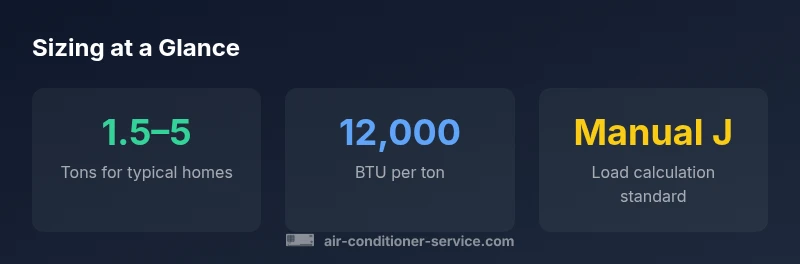
Choosing the right size for air conditioner is about meeting the house’s cooling load, not just square footage. In typical homes, AC capacity ranges from about 1.5 to 5 tons (18,000–60,000 BTU), with 12,000 BTU per ton; a proper Manual J calculation is the gold standard to avoid short cycling or insufficient cooling.
Why size matters for air conditioners
A correctly sized air conditioner provides consistent comfort, stable humidity, and energy efficiency. When a unit is too large, it cools quickly and then shuts off, a short cycling pattern that wastes energy and dehumidifies poorly. When it’s too small, it struggles to reach the set temperature on hot days, runs continuously, and forces the system to work harder. Both extremes can shorten equipment life and raise operating costs. According to Air Conditioner Service, the right size is determined by the house’s cooling load, not by guesswork or only by square footage. The best practice is a formal load calculation, typically a Manual J, performed by an HVAC professional. This calculation considers insulation, windows, air leakage, shade, occupancy, and climate zone to estimate the correct cooling capacity in BTU or tons.
Key takeaway: sizing governs comfort, humidity control, and long-term energy use. A precise load calculation eliminates common sizing errors and sets expectations for performance across seasons.
How sizing is determined: Manual J and load calculations
Sizing begins with a thorough load calculation. Manual J is the standard method used by many licensed HVAC contractors to quantify how much cooling a home truly needs. The process accounts for:
- Building envelope: insulation levels, air leakage, window orientation, and shading
- Internal heat gain: occupants, lighting, appliances, electronics
- Climate zone and outdoor temperatures
- Equipment efficiency and duct integrity
After gathering data, the calculator estimates total BTU demand and converts it into a practical system size (in tons). While DIY calculators exist, a professional Manual J assessment is the most reliable way to ensure you don’t oversize or undersize your new unit. Air Conditioner Service emphasizes that accurate sizing pays off through better humidity control and steadier cooling with lower energy consumption.
Climate, insulation, and home design influence sizing
Climate zone dictates peak cooling loads; homes in hot, humid regions generally need larger capacities per square foot than milder climates. Insulation quality, air sealing, and reflective roofing reduce the required capacity, sometimes allowing a smaller unit without sacrificing comfort. Lot orientation and shading can also change load, particularly in homes with wide glass exposures or poorly shaded south-facing walls. Ceilings, attic access, and ductwork efficiency further influence size: leaky ducts can undermine a correctly sized system by wasting conditioned air. A well-insulated home with efficient ducts often requires less peak cooling than a poorly insulated one, highlighting why site-specific calculations matter more than generic rules of thumb.
Sizing for different home types: apartments, single-family, and large homes
Different living arrangements demand different sizing strategies. A compact apartment might use a 0.5–1.5 ton unit, while a typical single-family home (roughly 1,000–2,000 square feet) often needs 1.5–3 tons. Large homes (2,500–4,000+ square feet) can require 3–5 tons depending on insulation and climate. These ranges are rough guides; precise sizing requires a load calculation that factors in window size, shading, ceiling height, and air leakage. In all cases, the goal is to match the unit’s capacity with the measured cooling load so the system runs efficiently without excessive cycling.
Common sizing mistakes and how to avoid them
Avoid common pitfalls that degrade comfort and increase energy use:
- Relying on square footage alone without a load calculation
- Choosing a unit based on past experiences or “what neighbors have”
- Overlooking attic insulation, duct losses, or window orientation
- Failing to consider humidity control, which is a bigger deal in hot climates
Prevention tips: insist on a Manual J analysis, check duct design for leaks, and request a commissioning check after installation to verify airflow and refrigerant charge. Air Conditioner Service notes that these steps yield the most reliable results and long-term savings.
How to verify size during installation and commissioning
Verification occurs during commissioning. The installer should confirm the system’s airflow targets and measure refrigerant charge and static pressure. A properly sized unit should balance supply and return air, provide comfortable temperatures across rooms, and keep humidity at moderate levels without excessive short cycling. If you notice cold spots, excessive noise, or frequent cycling, revisit sizing with the contractor. A re-evaluation may be necessary if the home has undergone significant changes since the original load calculation (renovations, new windows, or added attic space).
Professional testing, along with user feedback, ensures the system meets the calculated load and delivers the promised comfort.
Quick-start sizing checklist for homeowners
- Obtain a professional load calculation (Manual J) for accuracy
- Review insulation, window efficiency, and shading in your home
- Confirm the duct system is sealed and properly sized for the air handler
- Ask about equipment efficiency and the cooling season performance
- Ensure the contractor provides commissioning and air-flow measurements
- Plan for potential future changes like additional rooms or better insulation
- Consider climate-control needs beyond temperature, like humidity management
- Request a written sizing summary with BTU/ton values and expected performance
- Review warranty and maintenance requirements to preserve sizing integrity
Tools and resources to help you size accurately
Leverage credible tools and professional guidance to support sizing decisions. Start with a formal load calculation (Manual J) conducted by a licensed HVAC contractor. Use reputable online calculators only as supplementary references and never rely solely on a rule-of-thumb. Energy.gov and university extension programs often provide education on load calculations and HVAC efficiency. When evaluating proposals, compare BTU/ton values, ductwork design, and expected energy consumption with the same design conditions. Air Conditioner Service recommends pairing any sizing work with a thorough commissioning process to confirm performance before long-term use.
Long-term benefits of correct sizing: comfort and energy savings
Correct sizing yields steady temperatures, better humidity control, and predictable energy costs. Even when upfront costs are higher, correctly sized systems often save money over the life of the unit by reducing energy waste and extending equipment life. Homeowners who invest in proper load calculations typically experience fewer service calls, fewer repairs due to short cycling, and improved indoor air quality. The long-term payoff is enhanced comfort and a lower total cost of ownership, especially in climates with wide temperature swings and high humidity.
Sizing ranges by home type
| Home Type | Estimated Size (tons) | Estimated BTU Range |
|---|---|---|
| Small apartment | 0.5–1.5 | 6,000–18,000 |
| Mid-size single-family (1,000–2,000 sq ft) | 1.5–3 | 18,000–36,000 |
| Large home (2,500–4,000+ sq ft) | 3–5 | 36,000–60,000 |
Common Questions
What does size mean in air conditioning units?
Size refers to the cooling capacity, measured in BTU or tons. One ton equals 12,000 BTU. Correct size matches the building load to ensure comfort and efficient operation.
Size is about the unit’s cooling capacity, measured in BTU or tons. A properly sized system matches your home’s load for comfort and efficiency.
How is AC sizing determined?
AC sizing is determined using a load calculation, often a Manual J, which accounts for insulation, windows, climate, and occupancy. This method provides a precise capacity target rather than guessing based on room count or square footage.
Sizing uses a load calculation called Manual J to account for insulation, windows, climate, and occupancy. It's the precise method, not a guess.
Can I upsized or downsized after installation?
Changing size after installation is possible but costly and complex. It typically requires selecting a new unit and potentially reworking ducts. A properly sized system from the start minimizes the need for a future sizing change.
You can change size later, but it can be costly and involve significant work. Start with a correct size to avoid this.
Does ceiling height affect sizing?
Yes. Higher ceilings add volume that increases cooling load. Size should reflect not just floor area but total air volume, which a load calculation will include.
Higher ceilings mean more air to cool, so load calculations consider total volume, not just floor area.
What happens if my unit is too small?
A too-small unit struggles to reach set temperatures, runs continuously, and may fail humidity control, leading to discomfort and higher energy use.
If it’s too small, it runs constantly and can’t keep you comfortable, wasting energy.
What should I ask a contractor about sizing?
Ask for a Manual J calculation, request documentation of your home’s insulation and air leakage, and require commissioning tests showing airflow and temperature performance.
Ask for a Manual J, insulation details, and commissioning proof to ensure proper sizing.
“Sizing is the foundation of comfort and energy efficiency. Always start with a proper load calculation rather than relying on rules of thumb.”
The Essentials
- Always start with a load calculation, not square footage
- Oversized units waste energy and humidity control
- Undersized units struggle to reach setpoints on hot days
- Manual J is the industry standard for accuracy
- Commissioning confirms sizing after installation