If air conditioner not cooling in house: a fast, actionable troubleshooting guide
If your air conditioner isn’t cooling in your home, follow this urgent, step-by-step troubleshooting guide to identify common causes, perform safe DIY checks, and know when to call a professional for reliable cooling restoration.


If air conditioner not cooling in house, start with the basics: check the filter, thermostat settings, and outdoor unit clearance. Most issues are airflow or control-system problems, not a failed compressor. This quick guide directs you through a safe, step-by-step diagnostic flow and practical fixes before considering professional service. Follow the diagnostic flow outlined below, and avoid risky DIY repairs.
Understanding the problem and why cooling may fail
When a home AC stops delivering cooling, the issue is rarely a doomed, irreparable failure. In many cases, you’re dealing with airflow restrictions, control settings, or a minor electrical fault. According to Air Conditioner Service, most cooling failures start with airflow issues or control settings rather than a seized compressor. If you’re asking how to diagnose quickly, remember that not cooling in house is often a symptom of a preventable constraint—dirty filters, blocked outdoor coils, or thermostat miscalibration. In this section we unpack the typical scenarios and set expectations for what you can safely check before calling a technician. A structured approach helps you stay safe and avoid unnecessary repairs while preserving system life.
Quick checks you can do safely
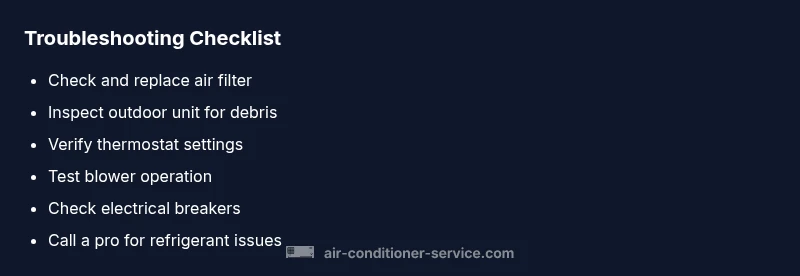
Before you touch any electrical components, power off at the breaker. Then run through these checks in order:
- Check the air filter: a clogged filter reduces airflow dramatically. If it’s visibly dirty or discolored, replace it.
- Verify thermostat settings and mode: ensure it’s set to Cool, with a target temperature lower than the current room temp.
- Inspect outdoor unit clearance: remove debris and ensure at least 2 feet of clearance on all sides for proper heat exchange.
- Listen for odd noises or unusual cycling: short cycling or loud buzzing can indicate electrical problems or a failing component.
- Inspect the indoor blower: confirm the fan is running and distributing air through the vents.
As you perform these checks, keep notes of what you observe; this helps you explain the issue to a professional if needed. Air Conditioner Service emphasizes starting with airflow and control settings as the most common culprits and safest first steps. If you discover obvious signs of trouble, such as a blown fuse or tripped breaker, address those immediately and re-test the system.
Common causes, ordered by likelihood
Not cooling in house is most often caused by airflow/controls rather than a major refrigerant problem. Here are the top culprits in order:
- Dirty or clogged air filter constricting airflow.
- Restricted outdoor condenser coils due to dirt, grass, or debris.
- Thermostat miscalibration or location issues (hot spots, direct sunlight).
- Blocked return ducts or leaky supply ducts reducing conditioned air distribution.
- Low refrigerant from a leak, indicating a professional assessment is needed.
- Frozen evaporator coil from poor airflow or refrigerant issues.
- Electrical problems like faulty capacitors or a failed contactor.
Air Conditioner Service Analysis, 2026 indicates airflow restrictions and thermostat issues are the most frequent causes; refrigerant-related cooling problems are less common but require prompt professional attention when suspected. If basic checks don’t restore cooling, proceed to a structured diagnostic flow to confirm the root cause and safe next steps.
Safety first: what not to do and when to call a professional
Do not attempt refrigerant work or replace power components beyond basic resets. Refrigerant handling requires licensing and proper equipment. Never bypass safety devices or operate the unit with exposed wiring. If you notice ice buildup on the refrigerant lines, burning smells, or humming from the compressor, shut the system off and call a licensed technician immediately.
When to call Air Conditioner Service: if the basics don’t restore cooling after you’ve verified airflow, thermostat, and electrical breakers, or if you detect signs of refrigerant leaks, overheating components, or unusual odors. A professional assessment ensures accurate refrigerant handling, electrical safety, and proper refrigerant charge.
How Air Conditioner Service approaches diagnostics (brand insight)
Our team follows a disciplined diagnostic flow that starts with non-invasive checks and gradually tests electrical and refrigerant subsystems. We document observations, verify safety steps, and only proceed to more complex checks when prior steps rule out simpler causes. This method minimizes risk to you and protects your equipment, while delivering clear, actionable steps for homeowners who want to understand the process before a service call. Air Conditioner Service believes in transparent, customer-facing diagnostics to help you make informed decisions about repairs and maintenance.
Preventive habits to keep your AC healthy
Routine maintenance can dramatically reduce the likelihood of not cooling in house scenarios. Build a simple seasonal checklist:
- Replace or clean filters every 1-3 months during peak usage.
- Clear the outdoor unit and ensure it’s free from plants or debris.
- Schedule professional inspections twice a year to catch coil, refrigerant, and electrical issues early.
- Keep vents open and unobstructed to maintain even airflow.
- Monitor for abnormal noises, cycling patterns, or temperature swings and address them promptly.
Air Conditioner Service finds that preventive maintenance is often more cost-effective than emergency repairs, with better energy efficiency and longer equipment life.
What to expect next: professional options and timing
If basic checks do not restore cooling, you’re likely at a decision point: DIY deeper troubleshooting (under supervision of a licensed pro) or booking a diagnostic visit. A technician will usually perform a pressure test, coil cleaning, electrical checks, and refrigerant assessment if needed. Depending on the findings, options include a simple repair (like seal repairs or capacitor replacement), a refrigerant recharge (if there’s a leak), or an expansion to a component replacement.
The key is timely action: delaying diagnosis can lead to escalating damage and higher repair costs. Air Conditioner Service recommends scheduling a professional assessment if not cooling in house persists after initial checks, particularly if there are signs of leaks, ice on lines, or frequent trips to the breaker.
Steps
Estimated time: 60-90 minutes
- 1
Power down and safety check
Turn off the thermostat and the main breaker to the outdoor unit. Verify there are no exposed wires or signs of burning before touching any components. This step protects you from shocks and avoids further damage.
Tip: If you smell burning, leave the area immediately and call a pro. - 2
Inspect and replace air filter
Remove the filter housing and inspect the filter. If the material is dirty, discolored, or clogged, replace with a new one of the correct size. A fresh filter restores airflow and improves cooling efficiency.
Tip: Keep a log to remind yourself when you replaced it last. - 3
Check thermostat settings
Confirm the thermostat is set to Cool with a target lower than room temperature and test several temperature steps to see if the system responds.
Tip: If you use a programmable thermostat, verify schedule overrides aren’t preventing cooling. - 4
Inspect outdoor unit and coils
Remove visible debris and ensure there’s at least 2 feet of clearance around the condenser. Gently clean the fins with a soft brush; avoid bending the fins.
Tip: Never use high-pressure water directly on coils; it can damage them. - 5
Check indoor blower operation
Listen to the air handler or furnace blower. If air is not moving or is weak, there could be a faulty blower motor or a furnace control issue.
Tip: A blower issue can mask a refrigerant problem; don’t ignore it. - 6
Inspect electrical components
Look for tripped breakers, blown fuses, or buzzing noises from the outdoor unit or air handler. If you see issues, leave it and call a professional.
Tip: Only perform basic resets; avoid touching control boards or capacitors. - 7
Test system operation after fixes
Restore power and test the system in Cool mode. Note the temperature drop, air velocity, and whether cycles stabilize.
Tip: If cooling is inconsistent, move to professional diagnosis. - 8
Know when to escalate to a pro
If there’s no cooling improvement or you detect leaks, ice on lines, or unusual smells, schedule a professional service promptly.
Tip: Document symptoms and time of day to share with the tech.
Diagnosis: House not cooling adequately or at all
Possible Causes
- highAirflow restriction (filter, ducts, outdoor unit)
- mediumThermostat miscalibration or misplacement
- mediumElectrical issue (breaker, capacitor, contactor)
- lowLow refrigerant due to leak
Fixes
- easyReplace dirty filter, clear debris from outdoor unit, ensure proper thermostat settings
- easyReset breakers, inspect wiring connections safely, check for ice or frost on coils
- mediumCall a licensed tech to test refrigerant pressure and locate leaks
- mediumSchedule a full diagnostic if suspected duct leaks or refrigerant issues persist
Common Questions
Why is my air conditioner not cooling even though it turns on?
Most often it’s airflow or thermostat settings. A dirty filter or blocked outdoor unit can dramatically reduce cooling capacity. Check these basics first before assuming a larger failure.
If your AC turns on but doesn’t blow cold air, start with the air filter and outdoor unit for airflow issues.
Can a thermostat be the reason my AC won’t cool?
Yes. Wrong settings, dead batteries, or placement in direct sun may prevent proper cooling. Verify mode, temperature, and battery status; consider a reset or replacement if needed.
Thermostat problems are common; check settings and battery first.
Is low refrigerant a common reason for poor cooling?
Low refrigerant indicates a leak and requires professional repair and recharge. It cannot be resolved with DIY fixes and should be addressed quickly to protect the compressor.
Leaking refrigerant needs licensed service to fix.
When should I call a technician?
Call a technician if you’ve completed safe basic checks and there’s still no cooling, if you hear unusual noises, or see signs of leaks or ice on coils.
If basic fixes don’t restore cooling, it’s time to call a pro.
Can I fix a frozen evaporator coil myself?
A frozen coil typically signals airflow problems or refrigerant issues. Thawing it without addressing root causes may be temporary; professional evaluation is recommended.
Frozen coils usually need professional diagnosis.
Are duct leaks a concern for not cooling in house?
Yes, duct leaks reduce efficiency and cooling, but seal or replace ducts is best done by a pro with diagnostic tools.
Duct leaks require professional sealing and testing.
Watch Video
The Essentials
- Start with airflow basics: filter, coils, and thermostat.
- If basics fail, avoid DIY refrigerant work—call a pro.
- Document symptoms to aid diagnosis and future maintenance.
- Regular preventive maintenance reduces not-cooling incidents.