How Many Decibels Does an Air Conditioner Make? A Practical Home Guide
Explore how many decibels an air conditioner makes, how to read dB ratings, and practical noise-reduction tips for quiet comfort in 2026.


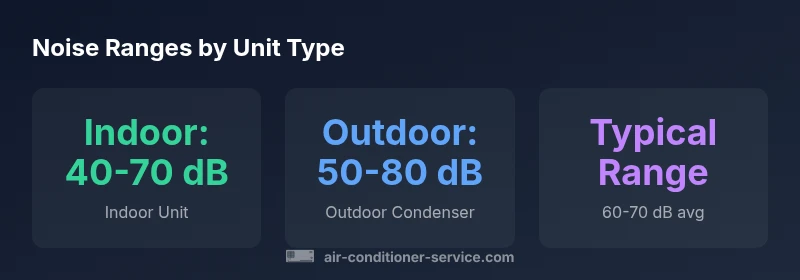
Most residential air conditioners operate within roughly 40-70 decibels for indoor units and 50-80 decibels for outdoor condensers under normal operation. Factors like unit type, installation quality, and distance from living spaces affect perceived noise. When shopping, compare dB ratings labeled on the unit, in the manual, and in independent testing reports.
What decibels measure and why they matter
Decibels (dB) are a logarithmic unit used to express sound intensity. When we talk about air conditioner noise, the rating you see in product specs is usually the sound power level or sound pressure level at a specific operating condition. In many cases, manufacturers present dB(A), which weights frequencies in a way that matches human hearing — this makes the rating more meaningful for everyday listening. Keep in mind that actual noise in your home depends on distance, room acoustics, and whether the unit is indoors or outdoors. A change from 50 dB to 60 dB may sound small, but it represents a substantial increase in perceived loudness due to the logarithmic scale. According to Air Conditioner Service analysis, these ranges vary by unit type and installation quality, so use decibel ratings as a starting point rather than a single universal threshold. When comparing models, check both indoor and outdoor dB values, and consider how placement will affect real-world listening in your living spaces.
Indoor unit sound profiles by type
Indoor noise primarily comes from the air handler fan and the compressor (for some heat pumps). In general, window units tend to produce more variability because the housing is less insulated and the condenser is closer to your ears; portable units can also wake a bedroom if placed on a nightstand. Split-system indoor units typically run quieter, especially in higher-efficiency models with better insulation. Typical indoor dB ranges seen in consumer guides are roughly 40-70 dB for common layouts, with ultra-quiet modes dropping toward the lower end. Air Conditioner Service analysis, 2026, notes that a quiet indoor unit may hover around 40-50 dB in normal operation, while better-insulated rooms or larger living areas can tolerate 60-70 dB without disturbance.
Outdoor condenser sound profiles
Outdoor condensers produce most of the audible noise; the compressor and fan drive the sound that travels through walls and windows. The range for outdoor-only noise on residential units commonly sits around 50-80 dB during running conditions, with larger or older models tending toward the higher end. Noise can be affected by weather, ambient background, and the presence of vegetation or walls that reflect sound. Manufacturers often publish the loudest operating point for the outdoor unit; use this as a baseline but remember that installation and clearance distances matter. Air Conditioner Service analysis, 2026 finds that outdoor noise is the biggest contributor to perceived home noise for many central systems.
How decibels translate to real-world listening
People perceive loudness non-linearly; a 10 dB increase roughly doubles perceived loudness, but actual impact depends on your room and distance. In a typical home, standing 1-3 meters from an indoor unit and 5-10 meters from an outdoor condenser can halve or more the perceived sound level. For bedrooms, the goal is usually to keep overall ambient noise below the level of late-night conversations (roughly 30-40 dB). But AC noise at the far end of a room can still mask soft sounds. The takeaway is to view dB ratings as a baseline and then evaluate how the unit performs in your own space. Air Conditioner Service emphasizes that context matters: two fans at the same dB can feel different depending on air flow direction and room geometry.
Installation and placement effects on noise
Where you place the indoor and outdoor units can dramatically change how loud they feel. A poorly isolated outdoor unit mounted on a thin wall or directly facing a bedroom can transmit more vibration and sound indoors. Use vibration pads, robust mounting, and fan speed controls to reduce amplification. Keep outdoor units away from windows and seats, and provide at least the recommended clearance per installation guidelines. Ductwork, if applicable, should be kept tight and insulated to prevent rattling and echo. A well-designed install reduces not only energy losses but also audible noise and gusty transients. Air Conditioner Service recommends consulting a professional installer to evaluate vibration isolation, duct routing, and clearance in your home environment.
How manufacturers rate noise and what to look for
Most manufacturers report dB(A) ratings for indoor and outdoor units, sometimes distinguishing between cooling and heating modes. When comparing models, read the labels on the unit and check the technical data sheet for the exact operating point (e.g., at 3/4 load). Remember that the labeled value is a rating under test conditions; real-world noise may be higher or lower depending on airflow, ducting, and external noise. Some regions require a sound power level in addition to the measured dB(A); if available, compare both. Air Conditioner Service notes that quieter models often use improved fan designs, better enclosure, and higher-quality vibration isolation, which together reduce perceived noise while preserving cooling performance.
How to measure your own unit's noise at home
To estimate your AC noise, pick a quiet time, run the unit in its normal mode, and measure at typical listening positions. Use a smartphone app calibrated for sound measurement, or an inexpensive decibel meter, held at about ear height and at a consistent distance from the unit. Take multiple readings at different locations around the room and average them to reduce anomalies. Note the mode (cooling/heating) and any operation like fan-only modes, which may be quieter. Record the external noise if you have an outdoor unit and compare your results to the unit's official dB values. Use this data to determine whether the unit meets your comfort needs. Remember that a few dB here or there may be due to wind, traffic, or HVAC system cycling.
Noise reduction strategies and practical fixes
Short-term fixes include placing the outdoor unit away from living spaces, using weatherproof vibration pads, and ensuring the unit is level and securely mounted. In individual rooms, you can add heavy curtains, rugs, and soft furnishings to dampen reflected sound. For central systems, consider duct insulation, acoustic duct liners, or a muffler box if allowed by code. Regular maintenance—clean filters, tighten screws, lubricate moving parts—can reduce rattling that seems to amplify noise. In some cases, upgrading to a newer, more efficient model or adding a sound blanket to the outdoor unit can noticeably reduce noise while preserving performance. Always consult a qualified technician before modifying airflow or mounting hardware.
Noise ranges by AC unit type
| Unit Type | Typical Noise Level (dB) | Notes |
|---|---|---|
| Indoor split-system | 40-50 dB | Quiet operation in living areas |
| Indoor window unit | 50-70 dB | Higher noise due to proximity to ears |
| Outdoor condenser (central AC) | 60-85 dB | Loudest component, near exterior wall |
| Portable AC | 50-60 dB | Moderate noise, depends on blower |
Common Questions
What is a safe decibel level for sleeping?
Sleep comfort varies by person, but most people notice sounds below 30-40 dB as quiet. For bedrooms, aim to keep AC noise below ambient nighttime levels; if you hear it clearly, try relocation or a quieter model.
For sleep, try to keep bedroom noise under 40 dB; otherwise consider placement changes or a quieter unit.
Do larger or newer AC units always run louder?
Not necessarily. Many newer models are quieter due to improved fans, enclosure design, and vibration isolation. Size can influence noise, but efficiency and engineering matter more for sound.
Newer models are often quieter because of better engineering—it's not just size that matters.
How can I compare dB ratings across models?
Compare labeled indoor and outdoor dB values under similar conditions (cooling mode, comparable load). Look for dB(A) values and test-condition notes to ensure apples-to-apples comparisons.
Look at the dB(A) ratings for each unit under the same test conditions.
Can installation or placement affect noise significantly?
Yes. Poor mounting, insufficient clearance, and direct alignment with living spaces can amplify noise. Proper vibration isolation and adequate clearance reduce transmission and echoes.
Placement matters a lot; good mounting can cut noise substantially.
Are there standards or certifications for AC noise?
Some regions require specified sound ratings and tests. Check local codes and examine the manufacturer's data for tested conditions and any certifications.
Some places have standards; always review local codes and the unit's data.
“"Noise levels matter as much as efficiency for occupant comfort. Focus on real-world measurements and proper placement to balance performance with quiet operation."”
The Essentials
- Read dB ratings for both indoor and outdoor units.
- Consider installation and placement to minimize noise.
- Measure noise in your space to verify real-world impact.
- Newer, well-designed models often offer quieter operation.
- Use practical sound-reduction strategies before replacing equipment.