What to Look For When Buying an Air Conditioner: A Practical Guide
A practical guide for homeowners and renters on selecting an air conditioner: size, efficiency, installation, and long-term costs to make a smart purchase.


By the end of this guide you’ll know what to look for when buying an air conditioner. You’ll learn how to size accurately by room, compare energy efficiency and noise, choose the right type for your space, and understand installation needs and warranty options. This workflow helps homeowners and renters make a smart, budget-conscious choice that keeps you cool without overspending.
What to Look For When Buying an Air Conditioner: A Practical Overview
Choosing an air conditioner is more than picking a model with a low price tag. The decision should balance room size, climate, noise tolerance, energy costs, and your installation constraints. This guide walks you through the core factors, from sizing and efficiency to installation considerations and long-term upkeep. It also emphasizes practical decisions you can make without pulling permits or tearing apart your space. Throughout, you’ll see how to compare options using clear, real-world criteria. According to Air Conditioner Service, focusing on sizing accuracy and energy efficiency yields the most noticeable comfort and cost benefits for most homes. The reader will learn to evaluate each option against concrete needs, not marketing claims, and will leave with a transparent shopping checklist.
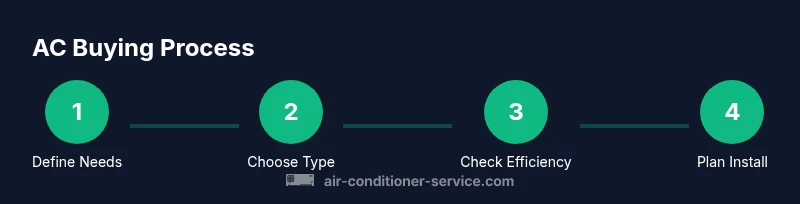
1) Define your cooling needs and space constraints
Before you shop, map out the spaces that need cooling and note any constraints (windows, vents, or ductwork). Consider occupancy patterns, sun exposure, and whether you need zone cooling or whole-home coverage. This step keeps your expectations realistic and prevents oversizing or undersizing. A practical approach is to list the highest-priority rooms and average daily usage, then layer in secondary spaces. Air Conditioner Service highlights that a well-defined use profile helps you pick a model that fits both space and lifestyle.
2) Understand types and where they fit
Air conditioners come in several forms: window units, portable units, ducted central systems, mini-splits, and package units. Each type has distinct installation needs, energy profiles, and cost implications. For renters and homeowners with limited space, window or portable units may be the simplest path. For larger homes, a mini-split or central system offers better performance and zoning capabilities. The choice should align with your space, permitting process, noise tolerance, and future plans for the room.
3) Size correctly: the BTU mindset
Sizing by BTU (British Thermal Units) is crucial. A unit that’s too small won’t cool effectively; one that’s too large will cycle on and off, wasting energy and reducing humidity control. The sizing process should factor room size, ceiling height, insulation quality, and solar gain. A standard rule of thumb is 20 BTU per square foot for typical rooms, but high ceilings, large windows, or sunlit spaces may require more. Use a BTU calculator or consult a professional to get a precise target for your space.
4) Energy efficiency: what SEER, EER, and inverter mean
Efficiency influences long-term operating costs as much as upfront price. SEER (Seasonal Energy Efficiency Ratio) measures cooling efficiency over a season; higher SEER means lower running costs. EER (Energy Efficiency Ratio) is a steady-state metric that's useful for hot climates. Inverter-driven or variable-speed compressors adjust output to match demand, improving comfort and efficiency at partial loads. When comparing models, look for higher SEER and, if possible, inverter technology for the best long-term value. Air Conditioner Service notes that the practical savings come from sustained efficiency, not just an impressive label.
5) Noise, airflow, and comfort features
Noise levels affect comfort, especially in bedrooms or home offices. Look at the unit’s decibel (dB) rating under typical operation, and check for features that improve airflow, such as multi-speed fans and well-designed louvers. Consider humidity control, programmable timers, smart thermostats, and sleep modes that optimize both comfort and energy use. A calmer room with consistent airflow often feels cooler than a louder, higher-output unit.
6) Installation considerations and permitting
Installation matters as much as the unit itself. Central and ducted systems require proper duct design, refrigerant lines, and electrical setup; window units have mounting and seal considerations that affect efficiency. If you’re renting, verify with your landlord about installation requirements and any permission you may need. Many regions require permits for new installations, and improper installation can void warranties. Prioritize models and installers who provide a clear, compliant installation plan.
7) Warranties, service, and expected lifespan
A robust warranty protects your investment against defects and premature failure. Look for 1–2 year limited warranties on parts and longer coverage for compressors. Evaluate service plans and availability of local technicians. Regular maintenance—like filter changes and coil cleaning—extends lifespan and protects efficiency. Air Conditioner Service recommends documenting the install and keeping records of maintenance visits for warranty claims.
8) Operating costs: estimating long-term value
Beyond the upfront price, estimate monthly electricity costs by multiplying usage hours by the unit’s wattage and your electricity rate. Higher efficiency reduces ongoing costs, especially in hot climates with long cooling seasons. If you have off-peak energy options or demand-response programs, check whether your model supports them. A more expensive unit may pay for itself over time through lower energy bills and fewer service calls.
9) Shopping strategy: how to compare models
Use a consistent comparison framework: BTU sizing, SEER, noise, warranty, and installed cost. Compare like-for-like models (same type and same capacity) to avoid apples-to-oranges comparisons. Read homeowner reviews to gauge real-world performance and reliability. Keep a running pros/cons list for each option and bring it to the retailer or installer to facilitate a clear decision.
10) Final questions to ask before purchase
Ask about installation timeline, permit requirements, required ductwork or electrical upgrades, and what is included in the warranty. Request a formal written quote that itemizes the unit, installation labor, permits, and any accessories. Confirm return policies and what would trigger a warranty claim. This practical check helps you avoid surprises after you buy.
Tools & Materials
- Measuring tape(Measure room dimensions (length x width) and ceiling height.)
- Floor plan or room layout(Have a simple sketch or app view of the space to map areas and any obstacles.)
- Notebook and pen(Record room data, preferences, and model comparisons.)
- Calculator or BTU calculator app(Compute required BTU and energy use estimates.)
- Smartphone or tablet(Access product specs and retailer pages.)
- Energy bill access (optional)(Helpful for estimating potential monthly costs.)
- Sound level meter (optional)(Check noise levels in critical living spaces.)
Steps
Estimated time: 30-90 minutes
- 1
Define cooling needs
Identify which rooms require cooling, usage hours, and any special considerations (sun exposure, high ceilings). This clarifies scope and guides subsequent sizing.
Tip: Create a quick usage profile for weekdays vs weekends to capture peak cooling demand. - 2
Assess installation type
Decide between window/portable units, mini-splits, or central systems based on space, budget, and permanence. Consider potential permits for larger installs.
Tip: If renting, confirm landlord approval and any restrictions before choosing a model. - 3
Calculate required BTU
Use room dimensions, insulation quality, and climate to estimate BTU needs. Avoid oversimplified rules; use a calculator for accuracy.
Tip: Round up to the nearest 100 BTU to avoid undersizing in bright, sunny spaces. - 4
Evaluate energy efficiency
Compare SEER ratings and note whether inverter technology is available. Higher SEER typically means lower operating costs over time.
Tip: Prioritize models with a dependable warranty and easy access to service. - 5
Check noise and airflow
Review decibel ratings and ensure the unit’s airflow meets room needs. Cooler rooms should not come with disruptive noise.
Tip: If possible, listen to in-store demonstrations or request a quiet mode test. - 6
Consider installation requirements
Confirm ductwork, electrical upgrades, and space for condensate drainage. Poor installation undermines efficiency and comfort.
Tip: Ask for a written installation plan with timelines before committing. - 7
Review warranty and service options
Assess coverage length, parts limits, and what service plans include. Check local technician availability.
Tip: Register your product and keep maintenance records for warranty claims. - 8
Get multiple quotes
Compare at least two to three models and installation quotes to gauge market pricing and value.
Tip: Bring a standardized comparison sheet to each seller to ensure apples-to-apples pricing. - 9
Confirm long-term costs
Estimate energy usage and potential savings with higher efficiency models to project payback periods.
Tip: Check for rebates or utility programs that can offset upfront costs. - 10
Make a decision and plan installation
Choose the model that best fits your needs and finalize installation arrangements, permits, and scheduling.
Tip: Schedule the installation window during a period of low humidity for best results.
Common Questions
What is the most important factor when buying an air conditioner?
Sizing and efficiency are usually the most critical factors. A correctly sized unit will cool efficiently and avoid humidity issues, while a high-efficiency model reduces long-term energy costs.
Sizing and efficiency are usually the most important factors. A correctly sized unit will cool well and save on energy costs over time.
Should I choose a window unit or a central system for a small home?
For small spaces, a window or portable unit is often the simplest and most affordable option. Central systems are better for whole-home cooling but require more planning and installation work.
For small spaces, window or portable units are often best. Central systems suit whole homes but need more setup.
What does SEER mean and what is a good rating?
SEER stands for Seasonal Energy Efficiency Ratio. A higher SEER indicates better efficiency; aim for 14 or higher where possible, and higher in hot climates.
SEER is a measure of efficiency; higher is better. Look for at least 14 or more if you can.
Do inverter compressors save energy?
Yes. Inverter compressors adjust speed to cooling demand, reducing energy use and improving comfort compared with fixed-speed units.
Yes. Inverters adjust to demand, saving energy and keeping you comfy.
How do I estimate BTU needs for my room?
Calculate BTU based on room size, ceiling height, insulation, and sun exposure. Use a BTU calculator for accuracy rather than rough rules.
Use a calculator for BTU based on room size and sun exposure.
How long does installation typically take?
Installation duration varies by system type but plan for a few hours to a full day for central or ducted installs.
Plan for a few hours to a day, depending on the system.
Watch Video
The Essentials
- Size your unit to the room for optimal cooling and humidity control.
- Prioritize higher energy efficiency (SEER) and, if possible, inverter technology.
- Consider installation impact and permits before buying.
- Compare warranties and after-sales service to protect your investment.