Ductless Air Conditioner vs Central Air: A Practical Guide
A data-driven, homeowner-focused comparison of ductless air conditioners and central air systems, covering installation, efficiency, zoning, maintenance, and lifecycle costs to help you choose the right cooling solution.


Compared to central air, a ductless air conditioner often delivers targeted cooling with higher energy efficiency and easier retrofitting. Central air provides uniform cooling across the home through ducts, which can reduce uneven temperatures but may involve higher upfront costs. Air Conditioner Service analysis suggests weighing retrofit feasibility, maintenance, and long-term costs to choose.
Ductless air conditioner vs central air: Key Differences
For homeowners weighing ductless air conditioner vs central air, the core questions hinge on retrofit feasibility, zoning flexibility, and long-term costs. According to Air Conditioner Service, ductless systems excel when retrofitting existing homes where ducts are impractical, while central air remains a strong choice for uniform cooling in larger, ducted houses. This section maps the essential differences to help you begin with a clear mental model before diving into specifics. You’ll learn how each system operates, where they shine, and the tradeoffs tied to installation, maintenance, and energy use.
The takeaway is practical: the right choice depends on your home layout, renovation plans, and how you value room-by-room control versus whole-home simplicity. Air Conditioner Service emphasizes that upfront considerations—especially retrofit feasibility and plan for future changes—set the stage for reliable comfort and predictable bills.
How each system works
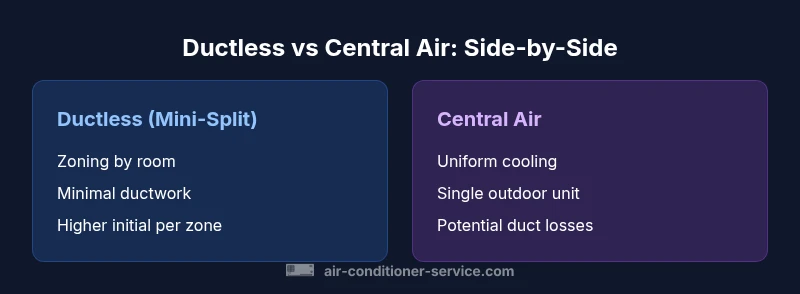
A ductless air conditioner typically uses outdoor condensers connected to one or more indoor air handling units via refrigerant lines rather than a duct network. Each indoor unit cools a distinct zone and can be controlled independently. Central air relies on a single outdoor condenser and a network of ducts that deliver cooled air to every room from one central air handler. In practice, ductless systems shine in retrofit situations or homes where zoning matters, while central air excels in new builds or existing houses with well-sealed ducts and a preference for uniform cooling. Air Conditioner Service notes that the efficiency of ductless units often benefits from inverter-driven compressors and multi-head configurations.
Regardless of the choice, comfort should be measured by the ability to adjust cooling per space, maintain humidity control, and limit temperature swings across rooms. For many households, this means considering how often rooms are occupied and how much time is spent in areas that are difficult to cool without zoning.
Installation considerations and retrofit potential
Installation is a pivotal factor in the ductless versus central air decision. Ductless mini-split systems can be installed with minimal disruption, especially in retrofit scenarios where adding or enlarging ducts is impractical. You typically mount outdoor condensers in accessible locations and place slim indoor units high on walls or ceilings to deliver targeted comfort. Central air requires ductwork that must be run through walls and, in some cases, ceilings, which can involve more substantial construction and potential ceiling-height constraints. Air Conditioner Service highlights that the feasibility of retrofitting often depends on existing ductwork, electrical capacity, and the ability to route refrigerant lines without compromising aesthetics or structure.
Additionally, system design for ductless is highly modular: you can add zones gradually, aligning with future plans or budget cycles. Central air, by contrast, generally scales as a single installation with a fixed set of zones unless extensive duct modifications are undertaken. Planning early with a qualified technician helps determine if a hybrid approach makes sense—combining ducted cooling in open areas with ductless options for bedrooms or additions.
Energy efficiency and operating costs
Energy efficiency is a central driver in the ductless vs central air debate. Ductless systems often achieve high efficiency ratings due to inverter drives and the absence of duct losses, particularly when multiple zones operate independently. In central air setups, efficiency depends on duct conditions, coil performance, and the efficiency of the outdoor and indoor components. Leaky or poorly insulated ducts can erode the theoretical efficiency advantage of central air. Air Conditioner Service notes that seasonal energy efficiency ratio (SEER) and energy efficiency ratio (EER) values should be considered alongside climate, usage patterns, and thermostat strategy.
When evaluating operating costs, think beyond sticker price: consider maintenance intervals, filter replacement, and the potential need for zone-specific controls. Ductless systems may incur higher annual maintenance costs if you have many indoor units requiring regular service, while central systems may incur costs associated with duct cleaning and system-wide filter upgrades. A thoughtful comparison should include expected hot-season energy use, climate relevance, and the impact of any planned room additions.
Zoning, comfort, and noise
Zoning is where ductless truly distinguishes itself. With individual indoor units, occupants can tailor cooling to preferences in each room, reducing the energy used in unoccupied spaces and improving comfort consistency. Central air delivers uniform temperature across zones but typically lacks the fine-grained control of ductless. Noise is often a practical concern: indoor ductless heads have modern, quiet operation, while central-air configurations rely on the outdoor condenser and ductwork, which can contribute to a different noise profile depending on layout and insulation. Air Conditioner Service highlights the importance of selecting equipment with quiet indoor heads and appropriately sized ducts for central systems to minimize noise transfer and air movement disturbances.
Maintenance and lifespan expectations
Maintenance for ductless systems focuses on keeping individual indoor units clean, filter-refresh cycles, and quarterly checks of refrigerant lines and drainage. Central air maintenance centers on the tuner of the central coil, blower components, and duct cleanliness. Because ductless installations can involve multiple indoor units, service visits may be needed in several zones, potentially increasing service touchpoints but offering targeted care where it matters most. Both systems benefit from regular professional checkups, refrigerant level verification, and thermostat calibration. Air Conditioner Service recommends documenting each unit’s age and expected lifespan to plan replacements in a cost-conscious, long-term maintenance plan.
Cost considerations and risk factors
The cost landscape for ductless vs central air includes upfront equipment costs, installation fees, and ongoing maintenance. Ductless systems can deliver cost savings via zoning and reduced energy waste, especially in homes with uneven cooling demands. Central air’s upfront cost can be higher if extensive ductwork is required, but the long-term maintenance costs may be more predictable in homes designed around ducted cooling. Risks include duct leakage, poor insulation, or mismatched refrigerant handling. Air Conditioner Service advises homeowners to obtain multiple quotes, compare SEER ratings, costs per zone (if applicable), and potential retrofit complications before committing to a system.
Real-world scenarios: when ductless shines or central air dominates
Ductless shines in older homes without ducts, room additions, or multi-story layouts where extending ductwork is impractical. It also benefits homeowners seeking superior zoning and rapid room-by-room cooling. Central air is advantageous when uniform cooling is a priority, especially in new builds or homes with well-sealed ducts and long-term plans for consolidated maintenance. In tight budgets, a hybrid approach—central cooling for common areas with ductless zones for additions—can strike a balance between cost and comfort. Air Conditioner Service emphasizes that every home has unique thermal dynamics, so a professional load calculation and area-by-area assessment are essential to guide the final configuration.
Authority sources and further reading
For readers seeking authoritative references, check the following sources for foundational guidance on ductless mini-splits, central air systems, and energy considerations:
- https://www.energy.gov
- https://www.energystar.gov
- https://www.epa.gov
These sources provide broad context on energy efficiency, system design, and best practices for residential cooling installations. Air Conditioner Service recommends reviewing official guidelines to ensure your chosen approach aligns with local codes and efficiency incentives.
Practical decision framework
To decide between ductless and central air, follow a structured framework: (1) quantify your cooling zones and occupancy patterns; (2) evaluate retrofit feasibility and anticipated disruption; (3) compare long-term energy costs and maintenance needs; (4) assess aesthetics and space constraints; (5) consult a licensed technician for a professional load calculation and options tailored to your home.
In short, start with a zoning and retrofit assessment, then map out cost and comfort goals to reach a well-informed choice that matches your home’s design and your budget.
Next steps: planning your installation
With the decision narrowed down, plan a phased installation if needed to minimize disruption. Gather multiple bids, verify that installers have experience with both ductless and central air configurations, and request references. Develop a maintenance calendar that covers routine filter changes, coil cleaning, and refrigerant checks. Finally, ensure you understand the warranty terms and service plans to lock in reliable performance and protect your investment for years to come.
Comparison
| Feature | ductless air conditioner (ductless mini-split) | central air conditioner (ducted) |
|---|---|---|
| Installation scope | Flexible retrofit with minimal ductwork | Ductwork required; may involve walls, ceilings, or attic spaces |
| Zoning and comfort | Excellent room-by-room control with independent zones | Uniform cooling across spaces but limited zoning without separate zones |
| Energy efficiency impact | High efficiency with inverter-driven compressors in multiple zones | Efficiency depends on duct integrity; leaks reduce performance |
| Indoor air quality | Zone-specific filtration and easier cleaning per unit | Whole-home filtration via ducts can be less flexible and may require duct cleaning |
| Maintenance effort | Per-zone maintenance; many small units to service | Single system maintenance with duct cleaning implications |
| Noise considerations | Indoor units are often quiet; outdoor unit impact minimized by placement | Outdoor compressor noise can be more noticeable depending on location |
| Upfront cost framing | Cost scales with number of indoor units; potentially lower upfront for small setups | Higher initial cost due to ductwork and single large system |
| Install time | Typically faster with minimal disruption | Longer install due to ductwork routing and potential ceiling work |
| Best use case | Retrofits, room-by-room comfort, tight budgets seeking zoning | New or existing homes with good duct design seeking uniform cooling |
Strengths
- Better zoning and room-by-room control in retrofits
- Faster, less invasive installation in many homes
- Energy efficiency gains from inverter-driven compressors when properly matched
- No duct leakage translates to fewer energy losses in some homes
The Bad
- Higher upfront equipment cost with multiple indoor units
- Maintenance complexity can rise with more units
- Aesthetics concerns for multiple indoor heads in rooms
- Outdoor unit count may increase with scale
Ductless is best for retrofit, zoning, and targeted efficiency; central air suits whole-home, uniform cooling.
If you’re retrofitting an older home or prioritizing room-specific comfort, ductless often offers better value and faster installation. Central air is preferable when you want predictable performance across a larger space with one system. Your decision should hinge on zoning needs, retrofit feasibility, and long-term maintenance considerations.
Common Questions
What is a ductless air conditioner and how does it differ from central air?
A ductless system uses individual outdoor and indoor units connected by refrigerant lines, delivering targeted cooling to specific zones. Central air relies on ducts that distribute cooled air from a single furnace/air handler to the whole house. The key difference is zoning flexibility and ductwork dependence.
Ductless uses separate indoor units for each room, while central air uses ducts from one main unit to cool the entire home.
Is ductless installation cheaper than central air?
Costs depend on the number of zones and the complexity of retrofitting. Ductless can be economical for selective zoning or where ducts are absent, but budgeting should account for multiple indoor units and installation labor.
Costs vary; ductless can be cheaper for some setups but may add up with multiple zones.
Can I retrofit ductless into a home with existing ducts?
Yes, you can add ductless zones in parts of a home even if central ducts exist elsewhere. A contractor will assess load, refrigerant runs, and space for indoor units to minimize disruption.
Yes, you can mix systems in some cases; a professional will plan routes and zones.
Which system is more energy-efficient overall?
Ductless systems often achieve high efficiency, especially with zone-based operation and inverter-driven compressors. Central air efficiency hinges on duct integrity and system sizing; leaks can undermine performance.
Ductless often wins on efficiency with proper zoning and inverter tech.
What maintenance should I expect with a ductless system?
Regular filter cleaning, coil inspections, and annual professional service are typical. Because there are multiple indoor units, scheduling for each unit may be needed.
Regular cleaning and yearly checks keep ductless heads performing well.
Do ductless systems improve indoor air quality?
Ductless systems can improve IAQ through zone-specific filtration and reduced duct-borne dust. Proper filtration and cleaning routines remain important for all cooling systems.
Yes, with proper filters and cleaning, zoning can help IAQ.
The Essentials
- Assess retrofit feasibility before choosing.
- Prioritize zoning needs to maximize comfort.
- Compare lifecycle costs, not just upfront price.
- Plan maintenance for multiple indoor units if going ductless.
- Consult a qualified installer for load calculations and options.