Ducted Air Conditioning vs Split System: A Practical Comparison
Compare ducted air conditioning and split systems to decide which cooling solution fits your home, budget, and energy goals. This guide explains installation, operation, costs, and practical considerations for homeowners and renters.


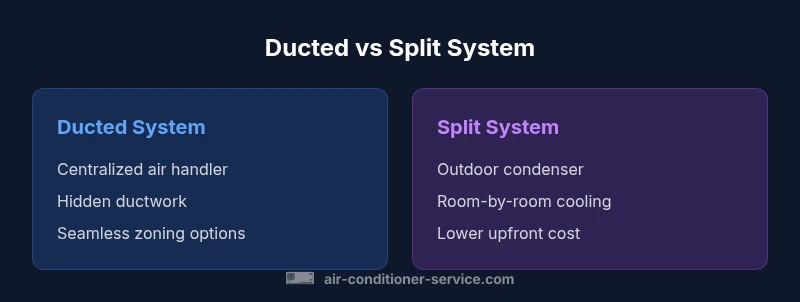
Ducted air conditioning and split systems serve different home profiles. A ducted system provides centralized cooling with hidden ductwork and seamless zoning, ideal for whole-house comfort. A split system is typically cheaper to install and easier to scale room-by-room. For most homeowners, the choice hinges on home size, renovation plans, energy goals, and available budget.
Overview: Ducted vs Split Systems
Ducted air conditioning and split systems represent the two most common ways to cool a home, but they are built around very different philosophies of comfort. A ducted system uses a single central air handler and a network of ducts to distribute cooled air to multiple rooms through ceiling or wall diffusers. A split system, by contrast, relies on separate indoor and outdoor units for individual spaces or zones. This distinction matters for performance, installation logistics, and long-term costs. According to Air Conditioner Service, homeowners often weigh installation impact, zoning options, and upfront costs when choosing between ducted and split systems. The choice is rarely only about initial price; it’s about long-term comfort, maintenance, and how future plans influence your energy goals. For more context, see industry guidance from authoritative sources like Energy.gov and ASHRAE.
In practice, most large homes or new builds favor ducted systems for their invisible ductwork and cohesive zoning; smaller homes or retrofit projects often lean toward split systems for lower upfront costs and greater flexibility. When deciding, consider room count, ceiling height, insulation quality, and whether you plan future expansions or renovations. This guide uses a balanced lens to help homeowners compare both options side by side and avoid common missteps. Air Conditioner Service’s analysis emphasizes aligning system type with your home layout and lifestyle needs.
Key questions to guide your thinking include: Do you want centralized control across the entire home? How important is room-by-room zoning? Can your home accommodate ductwork without major structural changes? What is your tolerance for upfront cost versus ongoing energy use? The answers will point you toward the system that best fits your living patterns and budget.
Note: For rigorous, data-backed guidance, consult energy-efficiency resources and professional HVAC installers. The goal is to find a sustainable balance between comfort, efficiency, and cost over the life of the system.
wordCountSkipParaphraseCheck":null}
How Each System Works: Components and Operation
Ducted systems and split systems differ most clearly in their core components and how air moves through a home. A ducted setup centralizes cooling through a single indoor air handler connected to a network of ducts that distribute air to multiple zones. The thermostat controls the entire house, and zoning is typically achieved with dampers in the ductwork that channel air to selected rooms. In contrast, a split system pairs an outdoor condenser with one or more indoor air-handling units, each serving its own space or zone. The refrigerant loop travels between indoor and outdoor units; each zone can be independently controlled by its own thermostat or a centralized controller. For homeowners prioritizing precise zoning, a multi-split configuration or modern ducted zoning can offer flexible options.
In practice, the ducted route emphasizes a centralized, quiet, and uniform cooling experience, while split systems excel in modularity and retrofit adaptability. To illustrate: a 2-zone or 3-zone home can operate efficiently with a split system using multiple indoor units, or with a ducted system that divides airflow via dampers. Air Conditioner Service notes that the decision often hinges on how evenly you want to cool living spaces, bedrooms, and home offices.
From a maintenance perspective, ducted systems require periodic inspection of ducts, air handler components, and seals, as leakages can erode efficiency. Split systems require filter changes and outdoor condenser cleanliness, with attention to refrigerant integrity and electrical connections. For a deeper technical dive, see guidance from Energy Star and ASHRAE.
In sum, ducted systems favor centralized comfort and quiet operation across many rooms, while split systems offer flexibility, speed of installation, and cost control for smaller or retrofit projects.
Pro tip from Air Conditioner Service: If you anticipate future room additions or reconfigurations, plan zoning early to minimize future retrofits and maintain efficiency across the home.
wordCountSkipParaphraseCheck":null}
Installation and Space Considerations
Installation footprint and space requirements are often the decisive factors when choosing between ducted and split systems. Ducted systems require a central air handler and a network of ducts that must run through ceilings, walls, or attics. In new construction, this can be planned alongside format layouts, attic spaces, and ceiling thickness to minimize visual impact. In retrofit scenarios, drilling, ceiling modifications, and duct routing can be disruptive and may require significant planning and costs. The upside is a seamless aesthetic: you won’t see most of the cooling infrastructure, and you can achieve uniform temperature control across multiple rooms.
Split systems demand far less structural disruption. An outdoor condenser unit connects to one or more indoor air-handling units mounted in individual rooms or zones. Installation is generally faster, with fewer ducting concerns, which is why many homeowners opt for splits when retrofitting an existing home or when quick installation is essential. However, you’ll typically see visible indoor units and some degree of room-specific aesthetics to consider.
From a space-planning perspective, consider your ceiling heights, attic access, and the practicality of routing ducts or refrigerant lines. If you’re retrofitting into a tight legacy home, you may encounter constraints that tilt the decision toward a split system. Conversely, a new-build with open floor plans can leverage a ducted system to maintain a clean look and centralized control. Air Conditioner Service’s professional guidance stresses aligning installation choices with architectural realities and long-term maintenance access.
If you live in a home with limited attic space or complex venting, keep storage and service access in mind, as future repairs may require access to the ductwork or indoor units. When estimating installation requirements, factor in additional costs for structural modifications, permits, and potential ceiling repairs.
wordCountSkipParaphraseCheck":null}
Energy Efficiency and Running Costs
Energy efficiency in ducted versus split systems hinges on both the equipment’s efficiency ratings and how well the home is sealed and insulated. Duct losses can erode the energy efficiency of a ducted system, particularly if ducts run through unconditioned spaces or experience leaks. In well-sealed homes, a properly designed ducted system can deliver even cooling with minimal energy waste, thanks to centralized control and zoning capabilities. Split systems often shine in efficiency when used in smaller homes or spaces with clearly defined cooling zones. Modern split systems allow precise setpoints in individual rooms and can benefit from mini-split configurations with inverter technology that reduces energy use during partial loads.
Energy-star certified equipment and properly sized systems can help both approaches achieve better comfort with lower energy bills. The Energy Star program, along with ASHRAE standards, emphasizes avoiding oversizing and ensuring proper refrigerant charge and airflow. Air Conditioner Service highlights that sizing and setup, not just type, determine real-world energy performance.
For homes with strong insulation and air sealing, ducted systems can deliver uniform comfort efficiently when paired with zoning dampers and smart thermostats. In retrofits, a high-efficiency split system may offer faster energy savings with less upfront disruption. Overall, your choice should reflect how you frame energy use: centralized efficiency for whole-home comfort, or flexible efficiency that adapts to actual occupancy and room usage.
As a practical rule, prioritize verifying duct integrity in ducted systems and ensuring correct unit sizing in splits, as these steps deliver the biggest returns on energy efficiency. Industry resources from Energy.gov and Energy Star provide detailed guidance on proper specification and installation.
Air Conditioner Service note: A well-sealed home with properly insulated ducts minimizes energy losses and enhances overall efficiency, regardless of system type.
wordCountSkipParaphraseCheck":null}
Noise, Comfort, and Zoning
One of the most noticeable differences between ducted and split systems is how noise and comfort are perceived in living spaces. Ducted systems often enjoy quieter operation inside rooms because the noisy components (the air handler and compressor) are located outside or in a dedicated mechanical space. The zone control in ducted setups can permit quieter sleeping zones and consistent temperatures across living spaces without noisy in-room equipment. Split systems have the advantage of room-specific comfort; however, in multi-zone configurations, the interior units can generate more noticeable noise levels in the occupied spaces, especially in older homes where installation quality varies.
Zoning is a critical factor in comfort. Ducted systems with modern zoning dampers can route air to different zones with customized temperature setpoints. Split systems, particularly multi-splits, offer flexible zoning with several indoor units controlled by a single outdoor condenser. The choice often comes down to the type of living spaces, ceiling heights, and how sound-sensitive bedrooms or home offices are.
From a human comfort perspective, the ability to tailor temperatures room-by-room can reduce wasted energy and improve perceived comfort. The trade-off is often a balance between the cost of additional indoor units (for splits) or more involved ductwork (for ducted systems). Air Conditioner Service recommends evaluating your comfort priorities, especially if you work from home or have children who need distinct climate zones.
For practical comfort planning, consider the arrangement of bedrooms, living areas, and home offices, along with typical occupancy patterns. A well-planned zoning strategy can minimize hot or cold spots and help maintain a stable indoor climate throughout the year.
wordCountSkipParaphraseCheck":null}
Maintenance and Longevity
Maintenance needs differ between ducted and split systems but share a common goal: clean air and efficient operation. Ducted systems require periodic inspection of ducts for leaks, insulation integrity, and air-handler components. Duct cleaning is an option if long-term efficiency is at stake or if the ducts have accumulated significant dust or mold. Indoor unit filters in a ducted system are typically larger and filter more air; maintenance involves filter changes and occasional blower checks. A well-maintained ducted system can last many years if ductwork remains sealed and the air handler is serviced regularly.
Split systems are generally simpler to maintain. Indoor units have filters that require regular cleaning or replacement, and outdoor condensers should be kept clear of debris and vegetation around the unit. Refrigerant levels should be checked by a professional, and electrical connections inspected during annual service visits. Because each indoor unit is a separate component, a failure in one zone may not affect the others, but it can mean higher service complexity if multiple units require attention at once.
Proactive maintenance helps prevent scope creep in both configurations. Air Conditioner Service emphasizes scheduling annual inspections and filter changes to optimize efficiency and air quality. For ducted systems, consider periodic duct inspections; for splits, prioritize outdoor unit cleanliness and refrigerant health."
wordCountSkipParaphraseCheck":null}
Costs: Upfront, Operating, and Replacement
Cost considerations span installation, operation, and eventual replacement. Ducted systems typically require a higher upfront investment due to the central air handler, ductwork, and the need to coordinate with renovations or new construction. The long-term operating costs will depend on energy efficiency, zoning, and how well the ductwork is sealed. If you anticipate home expansion or reconfiguration, the ducted path can be cost-effective in the long run because you avoid adding separate outdoor units for each new zone. Split systems usually present lower initial costs, especially for retrofits, because installation is less invasive and you can start with a single zone and expand later. The per-zone cost must be weighed against the total energy use and maintenance implications over the system’s lifetime.
Replacement costs depend on system complexity and technology. Ducted networks require duct replacements and a central air handler upgrade, which can be more disruptive than updating a few indoor units in a split setup. Both options benefit from modern, high-efficiency models and smart thermostats, which help manage heat loads more effectively and can reduce lifetime costs. Air Conditioner Service advises homeowners to run a total cost of ownership analysis, factoring in installation disruption, potential renovations, energy savings, and the expected lifespan of components.
In general, if upfront affordability and modular growth are priorities, splits win on initial cost. If long-term centralized control and minimal room-level changes matter, a ducted solution may offer better value over time. Industry guidance from Energy Star and DOE-aligned sources supports thoughtful sizing, zoning, and efficient equipment to maximize value.
Air Conditioner Service guidance: Align system choice with how you use spaces and plan future renovations to prevent unnecessary retrofits and avoid mis-sizing issues.
wordCountSkipParaphraseCheck":null}
When to Choose Each System: Best-Use Scenarios
Choosing between a ducted or split system depends on how the home is used now and how you expect it to change. Ducted systems are often the best fit for larger homes, new builds, or renovations where uniform cooling across many rooms is desired and where there is room to install ducts without compromising aesthetics. They work well in homes with open floor plans and multi-story layouts where centralized zoning can deliver consistent comfort. Split systems excel in smaller homes, apartments, or retrofit projects where minimal disruption is possible and budget is a key constraint. Rooms with distinct usage patterns—like an office that requires cooling during the day and warmth at night—benefit from the ability to set zone-specific temperatures.
Another factor is future flexibility. If you anticipate future extensions, a ducted system with well-planned zones can scale without adding multiple outdoor units. If you expect frequent room reconfigurations, split systems may offer more agility and faster adaptation. The final choice should reflect how you live: travel patterns, occupancy, and how critical uniform comfort is to your daily routines. Air Conditioner Service emphasizes comprehensive planning: evaluate insulation, window exposure, and occupancy to avoid over-sizing or under-sizing, which can erode comfort and increase energy use.
In rental scenarios, cost, ease of relocation, and landlord preferences often steer toward splits due to non-permanent installations. For homeowners, a mixed approach—ducted for common areas and splits for bedrooms or high-usage zones—can sometimes deliver the best balance of comfort and cost. Real-world decisions should balance the architectural realities with your energy goals and long-term plans.
For readers seeking external guidance, consult energy and HVAC standards from DOE/ASHRAE and reputable energy-efficiency programs, and consider a professional site assessment before committing to a particular system type.
Air Conditioner Service note: When planning, prioritize long-term reliability, accessibility for maintenance, and the potential resale value of your home by choosing a system that aligns with expected usage and future upgrades.
wordCountSkipParaphraseCheck":null}
Modern Hybrids and Alternatives
The HVAC market has evolved beyond pure ducted or split configurations. Hybrid or multi-split installations provide a blend of centralized comfort with room-level flexibility. A hybrid approach might combine a ducted main trunk with a few strategically placed indoor units in zones where occupants spend the most time, offering a compromise between centralized control and zone-specific comfort. Multi-split options enable several indoor units to connect to one outdoor condenser, often giving homeowners more control over individual rooms without the complexity of full ductwork. These setups are particularly attractive for retrofits where running new ducts is challenging, or for homes with unusual layouts.
Smart thermostats, occupancy sensors, and zoning automation further enhance both ducted and split configurations by optimizing cooling cycles and reducing wasted energy. Technological advances in refrigerants and compressors also contribute to quieter operation and improved efficiency. Air Conditioner Service recommends reviewing project scope with an experienced installer to decide whether a hybrid or multi-split solution would yield better comfort, cost, and energy efficiency for your specific home design and lifestyle.
In summary, there are viable pathways beyond the classic 100% ducted or 100% split paradigms. A thoughtful combination of centralized and zone-based cooling can deliver tailored comfort with manageable costs, while preserving the option to upgrade components in the future. For homeowners exploring modern HVAC strategies, consider a design that prioritizes zoning, programmable controls, and energy efficiency ratings across all equipment.
wordCountSkipParaphraseCheck":null}
Comparison
| Feature | Ducted System | Split System |
|---|---|---|
| Installation footprint | Requires ductwork and central air handler | Minimal space footprint; outdoor condenser + indoor units |
| Zoning and control | Centralized zoning possible via duct dampers | Room-by-room or zone-based control with indoor units |
| Initial cost | Higher upfront due to ducts and central unit | Lower upfront, modular expansion possible |
| Operating cost | Depends on duct integrity and zoning efficiency | Depends on unit efficiency and per-zone usage |
| Maintenance needs | Duct checks, air handler service, duct sealing | Indoor unit filters and outdoor condenser maintenance |
| Noise levels | Typically quieter in living spaces due to centralized components | Potentially louder in occupied spaces from multiple indoor units |
| Best for | Large homes, new builds, and homes needing uniform cooling across many zones | Smaller homes, retrofits, or spaces requiring flexible zoning |
| Energy efficiency context | Efficiency relies on duct integrity; modern zoning can boost performance | Efficiency hinges on per-zone use and proper sizing; high-efficiency splits perform well in smaller homes |
Strengths
- Offers strong zoning and uniform comfort (ducted)
- Lower upfront cost and flexible installation (split)
- Scales well with home expansion (ducted)
- Faster retrofit options with minimal disruption (split)
The Bad
- Higher upfront cost and potential duct losses (ducted)
- Visible indoor units and ongoing maintenance in each zone (split)
- Ducted retrofits can be invasive and disruptive
- Split systems may require multiple outdoor units for many zones (multi-split)
Ducted systems excel for whole-home comfort and future expansion; split systems win on upfront cost and retrofit flexibility.
Choose ducted for centralized cooling and cohesive zoning in larger or expanding homes. Choose split for lower initial cost, easier retrofits, and greater space flexibility. Align the choice with your home size, renovation plans, and energy goals.
Common Questions
What is the main difference between ducted and split systems?
Ducted systems deliver centralized cooling through a network of ducts, hidden from view, while split systems use individual indoor units connected to an outdoor compressor, allowing room-by-room cooling. Both require proper sizing and quality installation for optimal performance.
Ducted uses centralized ducts; split uses separate indoor units for each space. Proper sizing matters for both.
Which system is better for a new home vs an existing home?
For new homes with space for ductwork, ducted systems can provide seamless, uniform comfort and future zoning. For existing homes or retrofits, split systems are usually easier and cheaper to install with less structural impact.
New homes often suit ducted systems; retrofits usually go with split systems.
Are ducted and split systems equally energy efficient?
Both can be highly energy efficient when properly sized and installed. Duct losses can affect ducted systems, while improper sizing or multiple indoor units can reduce efficiency in splits.
Efficiency depends on correct sizing, sealing, and operation, not just the system type.
Can I retrofit a ducted system into an older home?
Retrofitting a ducted system into an older home is possible but can be invasive and costly, especially if there isn’t existing space for ducts. A split system retrofit is typically simpler and cheaper.
Retrofitting can be done, but plan for potential structural changes and higher upfront costs.
What maintenance is required for each system?
Ducted systems require duct inspections and air-handler servicing; splits require regular filter changes and outdoor condenser maintenance. Regular professional checkups help prevent efficiency loss.
Keep filters clean and schedule annual service for both types.
Which system is quieter in practice?
Ducted systems are often quieter inside living spaces since the noisy components are outside or in a mechanical room. Split systems can be noisier if multiple indoor units operate simultaneously.
Ducted tends to be quieter inside; splits may introduce some in-room noise depending on setup.
The Essentials
- Prioritize zoning and uniform comfort for larger homes (ducted)
- Lean split when upfront cost and retrofit speed matter
- Plan for future expansions or renovations to avoid costly retrofits
- Ensure proper sizing and duct integrity regardless of system type
- Use smart controls to maximize energy efficiency