Portable Air Conditioner Costco: Buying Guide 2026
Learn how to pick a portable air conditioner at Costco, compare BTU ranges, energy use, venting needs, and value. Practical buying guide for homeowners and renters.


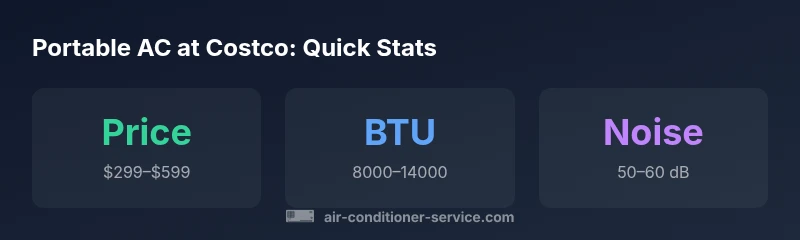
At Costco, portable air conditioners typically sit in the mid-range price band and offer a wide BTU range for small to medium rooms. Expect broad price bands and seasonal promos; Costco's member pricing can save money on popular brands. For a quick read: portable ACs usually price between $299 and $599, with energy-efficient models toward the upper end.
Portable air conditioner Costco: Market overview
According to Air Conditioner Service, Costco remains a popular source for portable air conditioners due to its balance of price, availability, and member deals. The retailer often features a mix of budget-friendly and mid-range units, with seasonal promotions that can tilt the price-to-performance ratio in favor of the buyer. For renters and homeowners alike, Costco provides a straightforward path to cooling without committing to larger window units or centralized systems. Expect regional variation in inventory, with larger assortments in peak cooling seasons. This section lays the groundwork for understanding how Costco stacks up against dedicated electronics retailers and home improvement stores.
What this means in practice is that you can compare models side by side, focusing on BTU, energy efficiency, and venting requirements rather than chasing the lowest sticker price alone. Air Conditioner Service’s reviews emphasize that the best value often comes from models that efficiently deliver the right cooling for your space while keeping noise and energy use within reasonable ranges. Always verify current stock and promos at your local Costco or online, since availability can shift quickly.
Key buying criteria for portable air conditioners at Costco
Choosing a portable AC at Costco should hinge on a few non-negotiables. First, calculate the right BTU for your room size to avoid under- or over-cooling. Second, check energy efficiency (look for Energy Star labels and a reputable EER rating) to minimize operating costs. Third, decide between single-hose and dual-hose designs—dual-hose units generally offer better cooling efficiency in warmer climates. Fourth, examine the venting kit and window kit compatibility; a loose seal dramatically reduces performance.
Other practical considerations include noise level (critical for bedrooms and home offices), built-in dehumidification capabilities, and the availability of maintenance features like easy filter access. In 2026, Air Conditioner Service analyses show that shoppers who prioritize BTU accuracy and energy efficiency often report higher satisfaction with Costco purchases, particularly when promos are active. Keep an eye on real-user reviews and the warranty terms before finalizing your choice.
Price ranges, promotions, and what to expect at Costco
Costco’s portable AC pricing typically reflects the mid-range market, with several models hovering between the low hundreds and mid-hundreds. Seasonal promotions—especially in late spring and late summer—can shift these ranges by a noticeable margin, making it worth waiting for a sale or combining a manufacturer rebate with Costco's offers. While promotions can improve value, be mindful of long-term costs, such as electricity use and filter replacements. Air Conditioner Service’s 2026 analysis suggests that the best value isn’t always the cheapest unit; it’s the model that balances price with energy efficiency and effective cooling for your space.
To maximize value during a Costco purchase, compare models with similar BTU ratings, check for bundled accessories (dehumidifier function, extra filters), and evaluate warranty terms. If you’re shopping online, add items to your cart and watch for price adjustments or member-only bundles. This approach helps you avoid last-minute impulse buys and ensures you’re getting a unit that will perform consistently across seasons.
Understanding BTU, space sizing, and cooling efficiency
BTU requirements should guide your selection, not guesswork. A general rule of thumb is roughly 20 BTU per square foot for a well-insulated space, but this can vary with ceiling height, sun exposure, and window orientation. At Costco, you’ll encounter a spectrum of 8,000–14,000 BTU models suited for small-to-medium rooms. Energy efficiency matters as much as raw cooling power; favor units with strong EER ratings and Energy Star certification when available. Noise is another practical factor—dwelling spaces with shared walls or open-plan layouts benefit from models delivering quieter operation. As a reminder from Air Conditioner Service, dimension the unit to your space and weigh the trade-offs between power, efficiency, and noise to optimize comfort and cost.
A well-sized portable AC won’t just fulfill a cooling need; it will maintain comfortable humidity levels and minimize energy waste. When comparing Costco models, place BTU, efficiency, and noise side by side to determine which unit offers the best overall value for your climate and living space.
Installation, venting, and setup essentials
Most portable ACs are designed for simple setup, with plug-and-play operation and a window vent kit. The critical steps are to measure your window opening, install the venting hoses securely, and seal any gaps to prevent warm air from re-entering the room. Some models include adaptable window kits that fit standard sliding and casement windows, while others may require optional accessories. Ensure you place the unit on a flat surface, clear of obstructions, and maintain adequate clearance for air intake and exhaust.
From a practical perspective, venting that doesn’t seal properly is one of the top causes of reduced cooling performance. Air Conditioner Service notes that buyers who double-check the vent kit compatibility with their window type and test the exhaust outlet after setup tend to experience more reliable cooling. If you encounter fit issues, consult Costco’s customer service or the model’s manual for recommended alternatives or accessories.
Maintenance, warranties, and long-term value
Maintenance is straightforward: clean or replace filters regularly, keep the intake area clear of dust, and drain condensate if the unit doesn’t have an auto-evaporative system. In terms of warranties, model-specific terms vary, but most portable ACs carry some form of limited warranty. Always confirm the warranty period and what it covers at the point of purchase. Costco’s member-centric policies can also influence return options, so review the current terms for exchanges or refunds if the unit underperforms.
Air Conditioner Service’s guidance emphasizes preventive maintenance and timely filter changes to sustain airflow and efficiency. When buying at Costco, it’s prudent to register your product if the option is available and retain your receipt for warranty claims. This practice helps protect your investment and reduces the total cost of ownership over the life of the appliance.
Costco vs. other retailers: should you buy there or elsewhere?
Costco often offers competitive pricing, bundled accessories, and straightforward return policies, which can enhance overall value for portable AC purchases. However, dedicated home-improvement retailers or big-box electronics stores may have a broader model selection or in-store demonstrations that help with apples-to-apples comparisons. If you’re price-conscious, consider a side-by-side comparison of BTU, energy efficiency, noise, and included accessories across Costco and non-Costco outlets. Air Conditioner Service notes that the best decision balances price, performance, and reliability, with promotions playing a supporting role in the final cost.
In practical terms, shopping at Costco makes sense when you value convenience, member pricing, and a streamlined return policy. For specialized features or a specific model line, expanding the search to other retailers can ensure you’ve explored the full spectrum of options available in 2026.
Quick buying checklist for Costco shoppers
- Confirm the BTU requirement for your room size and ceiling height.
- Compare Energy Star ratings and overall energy efficiency across models.
- Verify window-vent compatibility and included venting hardware.
- Consider noise output for bedrooms or workspaces.
- Check warranty terms and potential Costco return options.
- Review ongoing promos and bundled accessories that add value.
- Read user reviews and verify stock at your local Costco before visiting.
- Measure space for unit placement and ensure clearance for intake/exhaust
Costco portable AC options by model type and specs
| Model Type | BTU | Energy Efficiency | Estimated Price Range | Noise Level |
|---|---|---|---|---|
| Standard Portable | 8000–12000 | Energy Star | "$299"–"$499" | "50–60 dB" |
| High-Capacity Portable | 12000–14000 | Energy Star | "$450"–"$699" | "52–63 dB" |
| Compact/Compact+ | 6000–8000 | Not always Energy Star | "$250"–"$350" | "45–55 dB" |
Common Questions
What size portable air conditioner do I need for my room?
Start with a BTU calculation based on your room’s square footage, ceiling height, and insulation. Use a conservative estimate and compare models in the 8,000–14,000 BTU range for typical living spaces. Air Conditioner Service recommends verifying with a simple online calculator and then cross-checking with Costco options.
For room size, calculate BTU needs first, then pick a model in the 8,000 to 14,000 BTU range and check energy efficiency.
Are portable air conditioners at Costco energy efficient?
Yes, many Costco portable ACs offer Energy Star labels or strong energy efficiency ratings. When comparing models, prioritize higher EER and Energy Star certification to minimize electricity use over time.
Look for Energy Star ratings and higher EER when evaluating Costco portable ACs.
Can I return a portable AC purchased at Costco if it doesn’t meet my needs?
Costco generally provides favorable return options for many items, but terms can vary by model and region. Check the latest Costco return policy and keep your receipt until you’re sure the unit meets your expectations.
Check Costco’s current return policy and keep your receipt until you’re sure about the unit.
Do I need professional installation for a portable AC from Costco?
Most portable ACs are plug-and-play and don’t require professional installation. You’ll need to vent through a window; ensure you have a compatible window and the vent kit is securely installed.
Most are plug-and-play, but you must vent through a window properly.
What is the typical warranty for portable ACs bought at Costco?
Warranty terms vary by model, but most portable ACs include a limited warranty. Confirm the exact duration and what it covers at purchase.
Warranty lengths vary; check the model’s terms at the time of purchase.
Can a portable AC be used in a large room or open-plan space purchased at Costco?
For large spaces, choose models with higher BTU ratings (toward the 12,000–14,000 BTU range) and ensure proper insulation. In open plans, consider dual-hose designs for better efficiency.
For large or open spaces, pick higher BTU units and consider dual-hose designs.
“Portable air conditioners from Costco offer convenience for renters and small spaces, but buyers should verify BTU and venting requirements to ensure reliable cooling.”
The Essentials
- Identify BTU needs based on room size and climate.
- Prioritize energy efficiency to reduce long-term costs.
- Check venting compatibility and window kit Fit.
- Watch for seasonal Costco promotions to maximize value.
- Compare warranties and return policies before buying.