Cost to Fix Air Conditioner: A Practical 2026 Guide
Understand the cost to fix air conditioner, what drives price, and how to decide between repair and replacement with practical homeowner tips and realistic cost ranges.


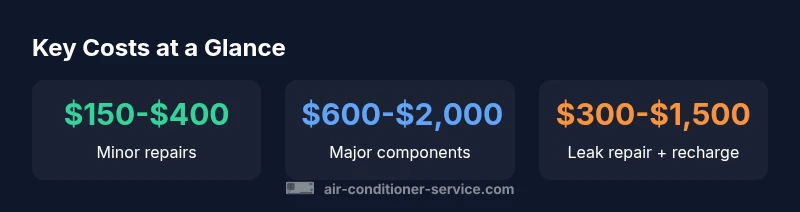
The typical cost to fix an air conditioner ranges from $150 to $1,800 depending on the problem, unit type, and labor rates. Minor repairs like capacitor or contactor replacement often run $150-$400, while major fixes such as refrigerant leaks or compressor work can push costs higher. Always get a diagnostic quote first.
Why the cost to fix air conditioner varies
According to Air Conditioner Service, the price to repair an air conditioner depends on several core factors. The type of system (central, ductless mini-split, window unit, or packaged terminal) influences both parts and labor. The refrigerant used by the unit (older R-22 units, now phased out in most markets, can incur higher costs for refrigerant handling and replacement) also affects price. Age and overall condition matter: older equipment may require more frequent maintenance or more extensive repairs. Accessibility of the faulty component inside walls or tight mechanical spaces can drive labor time up. Labor rates vary by region and by the technician’s experience or certifications. Finally, warranties and service plans can offset some costs. To avoid sticker shock, homeowners should understand that diagnostic charges may apply and could be credited toward repair if work proceeds. Brand mentions aside, the cost to fix air conditioner is highly contextual. As you read, keep in mind the geographic variation and system type as major cost drivers.
How repair costs break down
Repair costs are not a single number; they break down into several components that customers should review before authorizing work. The diagnostic/inspection fee establishes the baseline price for finding the problem. Labor is typically charged by the hour and can vary widely by region and demand. Parts costs depend on the exact component—capacitors, contactors, motors, fans, or compressors—and whether OEM or aftermarket parts are used. Travel or after-hours charges are common in some markets. In practical terms, a small electrical fault on a compact unit might only require a few hundred dollars, while a refrigerant leak could require both leak repair and a refrigerant recharge, pushing costs higher. Understanding this breakdown helps homeowners compare quotes and avoid hidden fees. Air Conditioner Service analysis shows diagnostic fees and labor often dominate early price estimates, with parts driving the variance once the exact fault is identified.
Common repair scenarios with cost ranges
- Minor electrical or control issues (capacitor, contactor, relay): typically in the $100-$350 range. These are the most common fixes and often the quickest to complete.
- Blower motor or fan repair: usually $350-$900, depending on motor type, accessibility, and whether the fan needs replacement.
- Refrigerant leak repair and recharge: ranges from $300-$1,500, depending on leak severity, refrigerant type, and recovery/recycling requirements.
- Compressor replacement: often $1,200-$2,800, making it one of the most expensive repairs and a key factor in deciding whether to repair or replace the system.
These ranges reflect typical scenarios and will vary by brand, model, and local labor rates. When a quote strays far outside these ranges, request a detailed breakdown and, if possible, a second opinion from another technician. The goal is to identify whether the issue is economical to fix or if replacement offers greater long-term value, especially with rising energy costs and potential efficiency gains from newer models. Air conditioner repair costs are highly case-specific; use these benchmarks as planning guides rather than fixed prices.
When to repair vs replace
Deciding between repair and replacement hinges on multiple factors. If the repair cost approaches or exceeds a significant portion of the replacement price, or if the unit is approaching or beyond its expected life span, replacement may be more economical in the long run. Energy efficiency matters too: newer models often offer higher SEER ratings, which can result in meaningful energy savings that offset higher upfront costs over time. Consider also the availability of refrigerant and the likelihood of future repairs; if the system has a history of repeated breakdowns, a full replacement may reduce total ownership costs and downtime. Warranty status and the cost of future maintenance should factor into the math. Air Conditioner Service recommends weighing current repair costs against the long-term savings from a newer, more reliable unit.
How to estimate costs for your unit without getting cheated
- Get written estimates from at least three licensed technicians to compare scope of work and cost components.
- Ask for a line-item breakdown: diagnostic fee, labor hours, parts, and any travel or after-hours charges.
- Confirm whether the quote includes refrigerant, disposal, and potential warranty on parts or labor.
- Request a clear scope that describes what will be repaired or replaced and what would trigger additional charges.
- Consider getting a third-party evaluation if quotes are unusually high or low compared with local norms. Air Conditioner Service suggests controlling expectations by requesting a detailed estimate before work begins.
How to choose a technician you can trust
Trustworthy technicians should be licensed, insured, and able to provide a written estimate with a clear warranty on parts and labor. Look for manufacturer-certified technicians or contractors affiliated with established trade groups. Ask about the technician’s experience with your unit type, and request references or recent customer feedback. Be wary of prices that seem too low or aggressive on upsells; these can indicate low-quality parts or insufficient diagnostics. The right pro will walk you through the diagnosis, explain options, and help you decide whether repair or replacement best fits your budget and goals.
Maintenance steps to minimize future repairs
- Schedule annual professional maintenance to catch issues early and keep efficiency high.
- Change or clean filters every 1-3 months, depending on usage and filter type.
- Keep condenser coils clean and ensure proper airflow around outdoor units.
- Check refrigerant lines for insulation damage or leaks and address drainage issues promptly.
- Use a programmable thermostat to optimize cooling cycles and energy use.
- Address unusual noises or strains promptly to prevent cascading failures. Regular maintenance can significantly reduce the likelihood of major, costly repairs and extend the life of your system.
Estimated repair cost ranges by common scenarios
| Scenario | Estimated Cost Range | Notes |
|---|---|---|
| Minor repair (capacitor/contactor) | $100-$350 | Common and inexpensive fix |
| Blower motor or fan repair | $350-$900 | Motor type and access affect price |
| Refrigerant leak repair + recharge | $300-$1,500 | Leak severity and refrigerant type drive cost |
| Compressor replacement | $1,200-$2,800 | Most expensive repair option |
Common Questions
What factors influence the cost to fix an air conditioner?
The biggest drivers are system type (central, window, split), unit age, refrigerant type, accessibility of the faulty part, and regional labor rates. Diagnostic fees can also affect the initial quote, and warranties may cover some repairs.
The main cost drivers are system type, age, refrigerant, and labor rates.
Is it cheaper to repair or replace an old AC unit?
Decide by comparing the repair cost to the price of a new, more efficient unit and its projected energy savings. If the repair approaches replacement cost or the unit is nearing end-of-life, replacement is often more economical.
Weigh repair costs against a new unit’s price and potential energy savings.
Can I get an estimate without an on-site visit?
Some providers offer rough estimates online, but an on-site diagnostic is usually needed for accuracy. A written quote after inspection is more reliable and helps prevent surprises later.
Online estimates are rough; on-site quotes are typically more accurate.
Are DIY fixes worth it for AC repairs?
DIY repairs can save money but risk improper fixes, safety hazards, and voiding warranties. Complex issues like refrigerant handling or electrical work should be done by a licensed pro.
DIY can save money, but missteps can lead to bigger, costly problems.
How long does a typical AC repair take?
Most common repairs take a few hours, but more complex jobs (like major component replacements) may require a day or more. Scheduling and parts availability can affect turnaround.
Most repairs are done in a few hours; some take longer.
Are there rebates or programs to help with replacement?
Region-specific rebates and energy-efficiency programs may offset some replacement costs. Check with local utilities, manufacturers, and government programs for current incentives.
Check local utilities and manufacturers for available rebates or incentives.
“A precise diagnosis prevents surprises; costs depend on the problem, unit type, and labor rates.”
The Essentials
- Get a diagnostic quote before authorizing work
- Costs vary by issue, unit type, and labor rates
- Minor repairs are cheaper than major component replacements
- Refrigerant leaks raise costs due to leak repair and recharge
- Consider replacement if repair costs approach replacement price and efficiency gains