Which Air Conditioner Is Less Energy Efficient? A Practical Comparison
A rigorous, evidence-based comparison of conventional window units, central AC, and ductless mini-splits to identify which is less energy efficient and why it matters for home energy costs. Includes ratings, scenarios, and upgrade paths with practical maintenance tips.


Conventional window units and older fixed‑speed central systems are typically less energy efficient than modern inverter models. The answer to which air conditioner is less energy efficient depends on use, load, and climate, but the pattern is clear: fixed‑speed appliances cycle on and off and waste energy during partial loads. In most homes, inverter or high‑SEER systems deliver the lowest energy use and best comfort.
Understanding energy efficiency in air conditioners
Energy efficiency in air conditioners is measured by how effectively a unit turns electrical power into cooling. When the thermostat calls for cooling, an efficient system keeps you comfortable with less energy waste. If you’re asking which air conditioner is less energy efficient, the best general rule is that older or fixed‑speed units tend to burn more watts for the same cooling load than modern variable‑speed designs. According to Air Conditioner Service, upgrades to inverter‑driven or high‑SEER units consistently reduce energy use in real homes, especially in hot climates with long run times. In this guide we break down three common types—conventional window units, central air with a two‑stage compressor, and ductless mini‑split inverter systems—and explain, in practical terms, how they perform under typical daily conditions. You’ll also learn how to read ratings and estimate operating costs, so you can avoid a choice that is unnecessarily energy-hungry. The goal is to empower homeowners and renters with clear criteria for comparing performance, rather than relying on marketing claims.
which air conditioner is less energy efficient and why it varies
The core differentiator is how the compressor and fans are controlled. Fixed‑speed or single‑stage units run at full capacity or off, which makes them efficient at peak loads but wasteful during partial cooling and mild days. In contrast, inverter‑driven units modulate output to match demand, reducing wattage at partial loads and smoothing temperature swings. In many households, inverter central systems or ductless mini-splits deliver lower energy use for the same comfort. The short answer to the question which air conditioner is less energy efficient is that older fixed‑speed window units, and some aging central systems, typically lag modern inverter designs. The Air Conditioner Service team notes that the difference is most pronounced during summer days with long runtimes, when every percentage point of efficiency translates into noticeable savings. In the following sections, we contrast three common configurations and provide practical decision criteria.
Side-by-side comparison of three common types
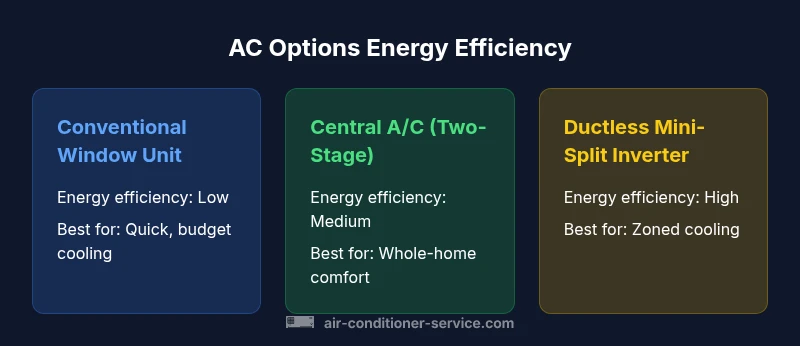
Here we outline the three most common configurations homeowners consider when evaluating energy efficiency: conventional fixed‑speed window units (or portable units), central air conditioning with a two‑stage or fixed‑speed compressor, and ductless mini‑split inverter systems. Each option has unique energy characteristics, space needs, and installation considerations. It’s important to contextualize these ratings with your home’s cooling load, insulation, and local climate. Note that energy efficiency is not the only factor; capacity and comfort, noise, ductwork, and maintenance also matter. This section introduces a structured comparison with a table, followed by scenario-based guidance.
Reading ratings and what they mean for your bills
Energy efficiency ratings such as SEER, EER, and COP provide a framework for comparing different AC configurations. A higher SEER or COP generally means lower operating costs for the same cooling capacity, though real-world results depend on climate, usage patterns, and proper installation. When evaluating which air conditioner is less energy efficient, it’s essential to look beyond a single metric and consider runtime, climate, and how the unit responds to partial loads. Air Conditioner Service recommends comparing units under typical summer conditions for your home and confirms that inverter-driven systems often outperform fixed‑speed designs in daily use. Always verify that the installation matches the unit’s rated capacity and that ducts, seals, and insulation are well maintained.
Practical scenarios and upgrade pathways
In practice, homeowners should map cooling needs to the most relevant technology. Quick rules of thumb: for small apartments or occasional cooling, a modern window or portable unit with a high efficiency rating can be an economical improvement over older devices. For larger homes or spaces with zoning needs, ductless mini-splits or high‑SEER central systems typically deliver the best energy efficiency, especially when paired with smart thermostats and optimized ductwork. If you already own a central system and climate is demanding, an inverter retrofit or a full system replacement could be worthwhile. The choice of which air conditioner is less energy efficient hinges on the current unit’s age, running patterns, and how well it’s matched to the space. Air Conditioner Service notes that energy savings compound over time when you align capacity with load and maintain equipment aggressively.
Costs, installation, and maintenance considerations
Upfront cost is a frequent hurdle when evaluating energy efficiency. Conventional window units have the lowest upfront price but can incur higher operating costs over time due to lower efficiency. Central air systems with two-stage or inverter-driven compressors carry higher initial costs but can yield substantial energy savings, especially in larger homes. Ductless mini-splits sit in between for pricing and offer flexibility with zoning. Maintenance needs differ: window units are simple to service, central systems require duct maintenance and refrigerant checks, and ductless systems demand regular filter cleaning and occasional refrigerant inspections. When deciding which air conditioner is less energy efficient, weigh not only the immediate price but also the expected energy savings over 5–15 years. The Air Conditioner Service team emphasizes budgeting for maintenance as part of the total cost of ownership.
How to maximize efficiency: startup checks and ongoing care
Regardless of type, several practices reliably improve energy performance. Clean or replace filters monthly during heavy use, seal ductwork or improve airflow paths, and schedule yearly professional maintenance. Use a programmable or smart thermostat to align cooling with occupancy patterns. Ensure outdoor units have adequate clearance for airflow and keep condenser coils clean. If your home experiences hot days with long run times, consider smart scheduling that reduces runtime during peak heat. Finally, invest in insulation improvements and reflective window treatments to reduce cooling load. These steps help close the gap between labeled efficiency ratings and real-world performance, making the answer to which air conditioner is less energy efficient less relevant to your daily bills. Air Conditioner Service recommends treating efficiency as a system attribute, not a single component.
Data sources and how we apply them
In compiling this comparison, we rely on standard industry ratings (SEER, EER, COP) and field-tested guidance from manufacturers and independent labs. We also draw on the Air Conditioner Service Analysis, 2026, to reflect current practice and typical homeowner experiences. When possible, we corroborate claims with trusted sources such as the U.S. Department of Energy and ENERGY STAR program data. This approach ensures the discussion remains factual and actionable, rather than speculative. For readers who want to verify specifics, we provide links to primary regulatory and research sources and explain how to interpret them in plain language.
Final thoughts on making the best choice for your home
Choosing between a conventional window unit, a central system, or a ductless inverter involves balancing energy efficiency with comfort, space, and budget. The most energy‑efficient option for one home may be different for another, depending on climate, insulation, and how the space is used. The key is to identify where you stand in terms ofUsage patterns, load, and willingness to invest upfront for long‑term savings. The culmination of this analysis is a clear decision path that prioritizes the option with the best long‑term energy performance for your specific scenario.
Feature Comparison
| Feature | Conventional window unit | Central air conditioner (two-stage) | Ductless mini-split inverter |
|---|---|---|---|
| Energy efficiency | Low | Medium | High |
| SEER/EER range (typical) | Low (≈10–12 SEER) | Mid (≈13–16 SEER) | High (≈17–20+ SEER) |
| Upfront price range | Low upfront cost | Medium upfront cost | High upfront cost |
| Maintenance complexity | Low | Medium | Medium |
| Best for | Budget-conscious cooling | Whole-home comfort | Zoned cooling with energy focus |
Strengths
- Lower upfront costs for window units
- Simple installation and fewer trades
- Compact footprint and portability
- Clear, easy-to-understand maintenance
The Bad
- Lower long-term energy efficiency than modern designs
- Limited cooling power for larger homes or high heat
- Potentially higher noise in some models
- Less integration with smart home systems
High-efficiency inverter systems generally offer the best energy efficiency, but consider climate, space, and budget.
Inverter-driven options typically deliver the lowest energy use for similar comfort levels. Window units may be appealing for small spaces or tight budgets, but their energy waste and limited capacity make them less suitable for long-term savings. A ductless inverter often represents the best balance of efficiency, flexibility, and comfort for many homes.
Common Questions
Which air conditioner tends to be the least energy efficient?
In most cases, older fixed‑speed window units or aging central AC systems have lower energy efficiency than modern inverter models. The key is how well the unit matches the cooling load and how often it cycles on and off. Upgrading to inverter or high‑SEER designs usually yields meaningful energy savings.
Older fixed‑speed units are typically the least energy efficient; upgrading to inverter models can save energy over time.
Is central air more energy efficient than window units?
Central air can be highly efficient if you choose a high‑SEER system and have proper insulation and duct sealing. In smaller spaces, a well‑sealing window unit can be competitive on a per‑square-foot basis but often won’t match the long-term energy performance of a modern central or ductless system in larger homes.
Central systems can be very efficient with good ducts and climate control, but for small spaces, window units may suffice.
What do SEER and COP ratings mean for my bills?
SEER measures seasonal cooling efficiency; COP measures the compressor’s efficiency at a specific condition. Higher numbers generally mean lower energy use for the same cooling load. Compare units using consistent climate assumptions and ensure the rating applies to the same capacity range as your home needs.
SEER and COP help you compare efficiency; higher numbers usually mean lower energy use.
How can I improve energy efficiency in an existing system?
Start with a professional tune‑up, clean or replace filters, seal ducts, and insulate. Use a programmable thermostat to match cooling to occupancy, and ensure condenser coils and outdoor units aren’t obstructed. These steps can significantly improve efficiency without replacing the unit.
Regular maintenance and smart controls can make a big difference.
Is it worth replacing an aging unit for efficiency gains?
If the unit is old and energy bills are climbing, replacing with a higher‑SEER inverter system often pays off over time through energy savings, despite higher upfront costs. Consider climate, insulation, repair costs, and how long you plan to stay in the home.
If energy bills are high and repairs are frequent, upgrading is often worth it.
The Essentials
- Assess your cooling load before choosing a type
- Prioritize high SEER/COP ratings for long-term savings
- Match system type to home size and climate
- Factor upfront cost against expected energy savings
- Maintain performance through routine service and air sealing