Can You Run RV Air Conditioner While Driving? A Practical How-To
Learn whether you can run an RV air conditioner on the road, the power sources needed, safety considerations, and step-by-step setups for generator or inverter-based systems. Practical guidance for RV owners seeking comfortable cooling while traveling.


Yes, you can run an RV air conditioner while driving, but only with a reliable 120V power source—usually a built-in generator or a high-capacity inverter paired with a sizeable battery bank. Shore power is ideal when parked. Avoid trying to power a standard RV AC from the vehicle’s 12V battery alone, since it won’t provide stable or safe AC power.
What powers an RV A/C unit and why it matters
RV air conditioners operate on standard 120-volt AC power. They are designed to be powered by shore power at a campsite, or by a built-in or portable generator that supplies 120V when you’re off-grid. A vehicle’s 12-volt battery cannot reliably power a roof-mounted A/C for more than a short period because the compressor and fan demand a high-capacity AC supply rather than DC. In practice, keeping a comfortable interior on the move depends on having a stable 120V source with enough wattage to handle the unit’s starting surge and continuous load. If you plan to run the A/C while driving, you must plan for how you will provide that 120V power without overloading your engine, alternator, or battery bank. The typical approach is one of three options: an onboard generator that runs when the engine is on or while parked; a high-capacity inverter paired with a sizeable battery bank; or occasional use of shore power at appropriate stops.
Air Conditioner Service notes that a properly configured setup prioritizes safety and reliability; that means choosing equipment with appropriate wattage ratings, ensuring proper ventilation for generators, and avoiding backfeeding into your vehicle’s electrical system. When in doubt, consult your RV’s manual or a qualified technician to design a power plan that fits your rig’s electrical architecture.
wordCount":null,
note_divider":null},
Tools & Materials
- On-board generator (recommended range: 2000–3000W)(Capable of delivering clean 120V AC with adequate continuous output; locate where exhaust can vent safely away from occupants.)
- High-capacity inverter (pure sine wave, 1000–3000W)(Use a quality inverter/charger paired with a compatible battery bank for reliable AC power on the road.)
- Deep-cycle battery bank (12V or 6V modules, sized for load)(Size to support the A/C load for the desired runtime; consider a bank with separate reserve for starting surges.)
- Battery-to-inverter connections and appropriate cabling(Use heavy gauge wires and proper fusing to prevent voltage drop or fire risk.)
- Ventilation and CO detectors(Essential for generator operation to protect occupants from exhaust gases.)
Steps
Estimated time: 45-60 minutes
- 1
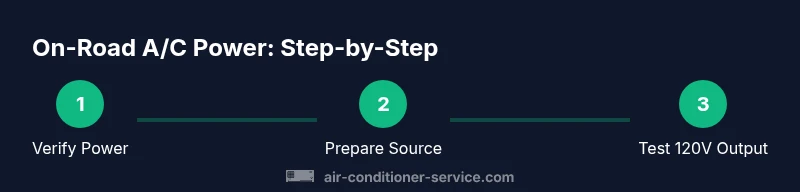
Verify power source and load
Confirm that your RV has a 120V power path for the AC unit and identify whether you’ll be using a generator or an inverter with battery bank. Check that the generator can supply the initial surge and that the inverter/battery setup can sustain continuous operation without overtaxing components.
Tip: Double-check electrical panel labeling and the AC circuit rating before starting any equipment. - 2
Prepare the power system for operation
Make sure the chosen power source is ready: if using a generator, ensure it’s in a well-ventilated area and connected safely; if using an inverter, confirm the battery voltage is within normal range and that all connections are secure.
Tip: Never start a generator indoors or in an enclosed space; keep CO detectors active. - 3
Power up and verify 120V supply
Power the generator or switch on the inverter and use a voltmeter or built-in monitor to confirm a solid 120V supply to the A/C unit. Listen for the compressor starting sound and observe that the fan comes on.
Tip: If you hear belt or bearing noises or see low voltage, shut down and re-check connections to avoid damage. - 4
Connect the A/C to the power source
Plug the A/C’s shore power cord into the RV’s outlet or connect the inverter's output to the AC distribution circuit per the manufacturer’s instructions. Ensure all safety covers are in place and the unit is secured.
Tip: Follow manufacturer order for connecting power to prevent arcing or accidental energization. - 5
Monitor load, battery, and fuel
Keep an eye on battery voltage, generator fuel level, and inverter temperature. If the load grows too high, consider reducing thermostat settings or switching to a different cooling strategy to protect electrical equipment.
Tip: A_COOLing load can spike during startup; plan for a brief surge and then steady-state draw. - 6
Drive with awareness and safety
Maintain safe speeds, observe road conditions, and ensure ventilation for any running equipment. If driving with a generator, monitor exhaust and cabin ventilation to avoid CO poisoning risks and to keep noise within local regulations, especially at night.
Tip: Limit idle time and avoid aggressive acceleration that could impact power stability. - 7
Conclude operation and shut down safely
When you reach your destination or no longer need cooling, power down the A/C by reversing the startup steps. Disconnect the shore power or inverter, turn off the generator if used, and store all cables securely.
Tip: Turn off and unplug only after the A/C and power source have cooled and are de-energized.
Common Questions
Can I run the RV air conditioner while driving?
Yes, if you have a suitable 120V power source—such as an onboard generator or a high-capacity inverter with a battery bank. Do not rely on a 12V supply, as it cannot reliably power most RV A/C units.
You can run the RV air conditioner on the road if you have a proper 120V power source, like a generator or a strong inverter. A plain 12V battery isn’t enough.
Is shore power required to operate the RV AC?
Shore power provides a stable 120V supply and is the simplest option when you’re parked. On the road, you’ll need a generator or inverter-based setup to supply the same 120V power.
Shore power is the easiest method when parked. On the road, you’ll rely on a generator or a big inverter.
Will running the AC drain my RV battery when driving?
Running on an inverter with a battery bank will draw from the batteries, and the bank can deplete if not replenished by the alternator or other means. Plan for charging while driving and monitor voltage.
Yes, a battery-based setup will drain the battery over time, so you need a way to recharge while driving and monitor battery levels.
Is it safe to run the generator while driving?
Most manufacturers do not recommend running a generator while driving due to exhaust, vibration, and safety concerns. If you do, follow the manufacturer’s guidelines and ensure proper ventilation and compliance with local laws.
Generators aren’t usually designed for driving. If you must, follow safety guidelines and keep exhaust vented outdoors.
Are there alternatives to running the AC on the road?
Yes. Use vent fans, shade, and strategic airflow; pre-cool when parked; use reflective window covers to reduce heat gain; consider smaller or energy-efficient cooling options.
You can cool your RV with fans and shade while parked, then use a more efficient approach when on the road.
What maintenance helps when planning to run A/C on the road?
Keep the generator serviced, ensure clean air filters, verify battery health, and test the inverter before a trip. Regular maintenance reduces the risk of outages during travel.
Regular maintenance keeps your A/C power system reliable, especially when you need it on the road.
Watch Video
The Essentials
- Power an RV A/C on the road only with a proper 120V source.
- Shore power is best when parked; generators or inverters enable on-road use.
- Monitor batteries, fuel, and exhaust safety to prevent hazards.
- Plan ahead for startup surges and cooling needs to avoid overloading systems.