Are RV Air Conditioners 12 Volt? A Practical Guide
Discover if RV air conditioners can operate on 12V, how 12V systems work, power needs, and practical off-grid cooling options. Learn when to choose 12V versus standard 120V RV AC.


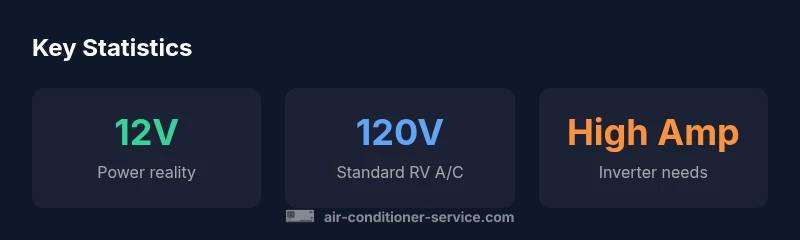
Are RV air conditioners 12 volt? In practical terms, no. According to Air Conditioner Service, most RV units run on 120 VAC via shore power or a generator. True 12‑V cooling options exist but are rare and usually limited in capacity, demanding large battery banks and high‑amp inverters. For off‑grid comfort, consider high‑efficiency fans or a properly rated 120‑V system with adequate power.
What does 12V mean for RV air conditioning?
In the RV world, 12V typically refers to direct-current power from a battery or an inverter-fed system. A true 12V air conditioner is not common because DC motors and heat exchangers are less efficient than 120V AC systems when scaled to typical RV cooling needs. For most campers, an air conditioner built for 120V AC that runs off shore power or a generator remains the simplest, most reliable option. When 12V cooling is discussed, it is usually a niche solution with limited cooling capacity and substantial power draw. That means you'll need a large battery bank and a high-amp inverter to maintain even moderate comfort levels for more than a few hours. This is why many RVers rely on fans, roof vents, or evaporative coolers for off-grid comfort, reserving 120V units for hotter climates or longer stays.
Why most RVs use 120V AC
The majority of RV air conditioners are designed for standard household power: 120V AC supplied from shore power, a generator, or a built-in inverter with a sizable AC rating. These units pair with climate-rated insulation, precise thermostats, and condenser/evaporator coils sized to deliver dependable cooling in diverse climates. The electrical infrastructure in most RVs—wiring, breakers, and shore power connections—supports this voltage with established transfer switches. Off-grid setups can still operate 120V units, but they demand careful planning to ensure the inverter, generator run-time, and fuel considerations align with travel patterns. This electrical compatibility is a core reason 120V systems dominate the RV market, despite the allure of 12V options for ultra-light setups or minimal-power campsites.
How 12V cooling options work (and when they make sense)
When a 12V option is pursued, designers frequently rely on high-current DC motors paired with efficient cooling cycles and, sometimes, refrigerant-based coils powered by inverters. The practical reality is that most 12V cooling solutions deliver far less BTU than a typical 13,500 BTU 120V RV AC, which limits applicability to small campers or summer nights with mild heat. If you do install a 12V system, you should plan for an oversized inverter, high-battery capacity, and robust battery management to prevent dips in voltage that could trigger cutoffs. For many users, 12V makes sense only for supplemental cooling (closing doors to reduce heat load) rather than as a primary climate-control solution.
Power planning for off-grid cooling
Power planning is the deciding factor when weighing 12V options. A 12V cooler consumes more amperage per BTU than its 120V counterpart, so you need to calculate your daily energy budget, battery state of charge, and inverter efficiency. A practical approach is to model your camping pattern: how many hours per day you’ll run cooling, how much solar you can harvest, and whether you have access to shore power. Your plan should include a buffer for start-up surges, as compressors often require a brief current spike. In many cases, a hybrid approach—a small 12V unit for milder days and a larger 120V unit for peak heat—delivers better comfort with lower risk to battery capacity.
Practical installation considerations
If you decide to pursue any 12V cooling, work with an electrician or an RV technician to size the inverter, battery bank, and wiring correctly. Common issues include voltage drop across long wire runs, improper grounding, and battery sulfation from deep discharge cycles. Another factor is cooling load placement: rooftop units vs. portable 12V systems each have different ducting, vent placement, and space requirements. Consider the thermal load of your RV: insulate windows, seal leaks, and shade the RV during peak sun to reduce the cooling load. These steps improve overall efficiency no matter which voltage pathway you choose.
Off-grid strategies and cost considerations
In off-grid contexts, cost considerations go beyond the appliance price. Inverter cost, battery capacity, and solar charging capabilities can quickly exceed the price of a robust 120V system. Evaluate total cost of ownership, including maintenance and potential replacement cycles. For many RV owners, investing in a reinforced insulation package and efficient 120V unit yields better comfort at a lower long-term cost than pushing for a 12V solution. Air Conditioner Service analysis suggests that the strongest path to reliable off-grid cooling is optimizing insulation, minimizing heat load, and selecting a 120V cooling solution that matches your battery and solar capacity.
Testing and maintenance for 12V setups
If you install a 12V system, routine testing and maintenance are essential. Check connections, monitor voltage under load, and regularly test the inverter’s efficiency. Replace or repair corroded links, inspect fuses, and verify battery health. Keep a log of charging cycles and runtime to anticipate replacements before failures occur. For 120V systems, annual checks of the electrical supply, thermostat calibration, and condenser cleanliness are usually sufficient to maintain peak performance.
Making the right choice for your RV cooling needs
Ultimately, your best option depends on how you use your RV, your off-grid ambitions, and your comfort expectations. For most users, a properly sized 120V RV A/C unit that can run on shore power or generator offers dependable cooling with manageable power requirements. If you frequently camp off-grid for extended periods and cannot rely on consistent shore power, plan for sizable energy storage and consider a hybrid approach or robust fans and ventilation. The key is to optimize heat load, match the cooling capacity to space, and ensure your electrical system can safely support your chosen solution.
Comparison of 12V vs 120V RV A/C basics
| Aspect | 12V viability | 120V standard |
|---|---|---|
| Power draw (approx) | hundreds of watts depending on inverter and efficiency | medium to high depending on unit (600-1500W typical) |
| Cooling capacity | limited to small spaces (roughly 3000-6000 BTU) | typical RV units around 13,500 BTU+ |
| Installation complexity | high due to battery/inverter requirements | low to moderate with shore power |
| Operational cost | high fuel/electricity with continuous use | lower per-hour cost with shore power |
Common Questions
Can you run an RV air conditioner on 12V power?
12V cooling is uncommon and usually impractical for full-sized RVs, due to high power demands and limited cooling capacity. A 120V system with shore power or a generator remains the typical choice.
12V cooling is rare and power-hungry; most RVs use 120V AC.
What amperage would a 12V RV AC draw?
Inverter-driven 12V options typically require very high current, often hundreds of amps, making large battery banks and robust inverters essential.
High current draw means big batteries are usually needed.
Are there cost-effective 12V cooling options for RVs?
Yes, but cost-effectiveness depends on battery and inverter costs; alternatives include roof vent fans and evaporative coolers.
Fans and evaporative coolers can be cheaper for light use.
What about 120V alternatives off the grid?
Off-grid RV cooling often uses a generator or inverter with a substantial battery bank; shore power is easiest when available.
Shore power or a generator is the simplest off-grid option.
How can I estimate my RV's cooling needs?
Consider space, insulation, climate, and occupancy; a professional load calculation helps size equipment and power needs.
Think about insulation and space when sizing.
Are there safety considerations with 12V HVAC setups?
Yes, ensure proper wiring, fusing, ventilation, and battery management to avoid hazards.
Electrical safety matters—get it right.
“For most RV owners, a properly sized 120V air conditioner paired with reliable shore power or a generator remains the simplest, most efficient cooling solution. 12V options exist but require careful power planning.”
The Essentials
- Understand that 12V RV A/C is uncommon and power-hungry
- Rely on 120V systems for most off-grid needs
- Plan inverter and battery capacity for any 12V option
- Consider alternative cooling like vents and fans
- Choose off-grid readiness based on camping style