What size air conditioner for 1600 square feet
A data-driven guide to sizing central and ductless cooling for 1600 sq ft homes, including BTU ranges, climate impacts, and professional methods.


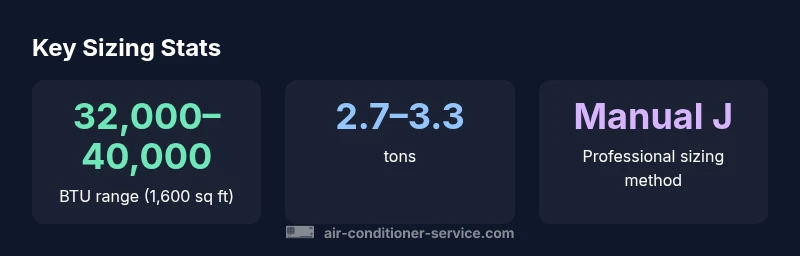
For 1,600 square feet, a typical central air system ranges from about 32,000 to 40,000 BTU total capacity (approximately 2.7 to 3.3 tons). The exact size depends on insulation, climate zone, and layout; oversizing or undersizing can result in comfort problems or inefficiency. A professional Manual J calculation is the best way to confirm the right size.
Understanding the sizing landscape for 1600 sq ft homes
According to Air Conditioner Service, the right cooling size for a 1,600-square-foot home starts with practical estimates and a whole-house load assessment. While many homes can be paired with roughly 32,000–40,000 BTU systems (about 2.7–3.3 tons), the final size depends on climate, insulation, shading, and layout. A properly sized system balances effectiveness with efficiency, reduces cycling, and maintains comfortable humidity levels. This section lays out what sizing actually means, why the numbers matter, and why a professional assessment is essential for real-world comfort and energy use.
Sizing is not simply about “bigger is better.” An oversized unit will cool a room quickly but often fail to dehumidify, leading to clammy conditions and higher energy bills. An undersized system, by contrast, will run constantly without achieving even temperatures. The goal is a balanced load that matches how your home loses and gains heat, how it’s used, and how much you want to spend upfront and over time.
The sizing rule of thumb: BTU per square foot and adjustments
A common starting point is about 20 BTU per square foot for a moderate climate with decent insulation. For a 1,600 sq ft home, that equates to roughly 32,000 BTU, or about 2.7 tons. In hotter climates or for homes with poor insulation or large sun exposure, you might push toward 25 BTU/ft², which nudges the target up to about 40,000 BTU (3.3 tons). Conversely, highly energy-efficient homes with excellent shading and tight envelopes might perform comfortably with closer to 18–19 BTU/ft² in mild zones. These are rule-of-thumb ranges; the exact needs hinge on climate, construction quality, and the number of occupants who regularly heat or cool the space.
Climate zones and insulation: how they tilt needs
Climate zone and insulating quality dramatically affect cooling load. A home in a mild climate with walls and attic well insulated, tight windows, and reasonable shading will typically require fewer BTU per square foot than a sun-drenched, poorly insulated house. Solar gain through windows, duct efficiency, and air leakage all add to the load. Air Conditioner Service analysis shows that insulating upgrades and air sealing can reduce the required cooling load by significant margins, sometimes enough to move a 1,600 sq ft home from 40,000 BTU down to the mid-30,000s. The takeaway: climate-informed sizing intersects with building performance.
Layout, shading, and window placement: practical influences
Two-story homes, large open floor plans, or a lot of glass facing the sun will increase cooling needs in hot months. Conversely, good shading from trees, overhangs, and energy-efficient windows can cut peak loads. Open floor plans may benefit from zoning or multiple smaller indoor units to balance temperature. If the home has large attic spaces or poorly insulated ducts, those hidden loads must be considered in the final sizing.
Sizing methods in practice: Manual J and professional checks
Manual J is the industry-standard load calculation used by licensed HVAC professionals to size equipment accurately. It accounts for wall and attic insulation, window areas, air leakage, occupancy, equipment efficiency, and thermostat settings. A site visit and sometimes a blower door test are common components. While DIY estimates can be a starting point, a certified professional will perform a formal calculation and translate the result into equipment size (BTU) and duct design that match the home.
System options for 1,600 sq ft homes: central, mini-split, and windows
Central air remains the most common solution for 1,600 sq ft homes, typically in the 32,000–40,000 BTU range (2.7–3.3 tons). Ductless mini-splits offer zoning flexibility and are especially useful for homes with multiple distinct zones or where retrofitting ductwork is impractical. Window units provide lower upfront costs and can cover specific rooms, though they’re rarely ideal for full-home cooling of this size. When planning, consider installation costs, long-term energy use, and whether a zone-by-zone approach might improve comfort and efficiency.
Practical steps to get properly sized: what to ask and checklists
Begin with a professional assessment. Ask for a Manual J calculation and, if possible, a Manual D (duct design) review. Request airflow and duct leakage tests, and evaluate attic insulation, window performance, and air sealing. Compare the long-term energy costs of different system types, including potential tax credits or incentives for efficiency upgrades. Finally, set comfort goals—do you prioritize humidity control, rapid cooling, or quiet operation—and choose an option that aligns with those goals.
Sizing options by system type for a 1,600 sq ft home
| System Type | Typical Size (BTU) | Tonnage | Pros | Cons |
|---|---|---|---|---|
| Central ducted | 32,000–40,000 | 2.7–3.3 | Even cooling, quiet | Higher upfront cost |
| Ductless mini-split | 24,000–42,000 | 2.0–3.5 | Flexible zoning | Requires more planning and potential higher maintenance |
| Window unit | 8,000–12,000 per unit | 0.7–1.0 per unit | Low upfront cost | Limited area coverage and aesthetic impact |
Common Questions
What size BTU is recommended for 1,600 sq ft?
A typical range is 32,000–40,000 BTU (2.7–3.3 tons). The exact size depends on climate, insulation, and layout. A Manual J calculation provides the precise recommendation.
For 1,600 square feet, expect around 32,000 to 40,000 BTU, but a professional Manual J is needed for exact sizing.
Can you oversize an air conditioner for this space?
Oversizing often reduces humidity control and causes short cycling, which wastes energy and reduces comfort. It’s better to size to the load and use zoning if needed.
Oversizing hurts humidity control and efficiency. Proper sizing with zoning is usually the smarter approach.
How does insulation affect cooling needs?
Better insulation and air sealing reduce the cooling load, sometimes by a sizable margin. This can move the required BTU downward and improve overall efficiency.
Good insulation lowers your cooling needs, which can save energy and reduce equipment size.
Is a ductless mini-split a good option for 1600 sq ft?
Ductless systems are great for zoning and retrofits where ductwork is impractical. They can cover 1,600 sq ft well when placed in multiple zones.
A ductless setup can be ideal for zoning but plan for installation costs and multi-zone control.
Do I need a professional for sizing?
Yes. A licensed HVAC professional should perform a Manual J calculation and evaluate duct design to ensure accurate sizing and airflow.
Absolutely—get a professional Manual J and duct check for the right size.
“"Sizing is the foundation of comfort and efficiency. Without it, even the most efficient unit wastes energy and money. A precise Manual J calculation helps balance cooling load, humidity, and energy use for a 1,600 sq ft home."”
The Essentials
- Start with a 32,000–40,000 BTU target for 1,600 sq ft.
- Insulation, windows, and climate zone greatly affect size.
- Get a Manual J calculation to confirm the final size.
- Avoid oversizing to maximize efficiency and comfort.