Is it air conditioner or air conditioning? A practical guide
Discover whether to say 'air conditioner' or 'air conditioning,' when to use each term, and practical tips for homeowners on terminology and maintenance. Learn how language affects communication with techs and suppliers.


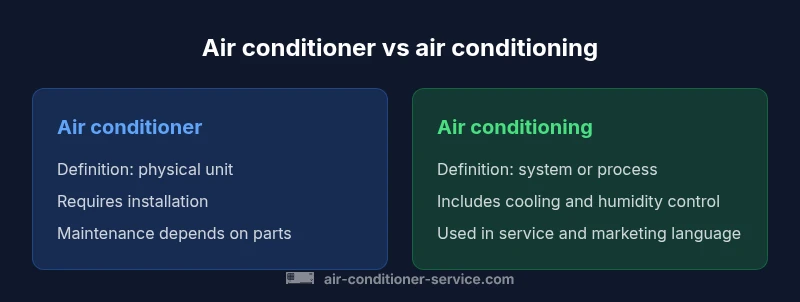
Is it air conditioner or air conditioning? In everyday use, both terms refer to cooling systems, but 'air conditioner' typically denotes the physical unit, while 'air conditioning' describes the overall system or field. For homeowner discussions and product labels, use 'air conditioner' when naming the unit and 'air conditioning' when talking about the cooling system or service in general. This distinction helps clear communication with technicians.
The Core Question: is it air conditioner or air conditioning?
For many homeowners and renters, the question is literally 'is it air conditioner or air conditioning?' The short answer is that both phrases describe the same cooling function, but they emphasize different aspects of the system. In practice, people use 'air conditioner' to name the physical unit, such as a window unit or split-system compressor, while 'air conditioning' refers to the broader cooling process, the installed system, or the service you hire. Understanding this distinction helps prevent miscommunication with technicians, sales staff, and warranty documents. Throughout this guide we treat the terms as part of a spectrum of usage rather than a strict rule, and we discuss how to apply them in everyday conversations, product labeling, and service requests.
Historical origin and evolution of the terms
The phrases 'air conditioner' and 'air conditioning' emerged from the same cooling technology but gained different shades of meaning over time. Early marketing and manuals tended to focus on the device itself—the physical unit—while industry texts increasingly used the broader phrase to encompass the full cooling process, maintenance, and installation workflows. This evolution makes the distinction useful in certain contexts, but the boundary remains flexible. For homeowners, the key is consistency: pick one framing for a given document or conversation and stick with it to avoid confusion.
From device to system: how terms map in real life
Think of the 'air conditioner' as the hardware—the compressor, condenser, evaporator, and the control panel. 'Air conditioning' covers the processes, the system as a whole, and the services that keep it running: installation, maintenance, diagnosing issues, and repairs. When a retailer advertises an 'air conditioner,' they likely mean the unit itself. When a service provider mentions 'air conditioning,' they are referring to the overall cooling setup or the service you might request. This mapping helps when ordering parts, scheduling service, or reading warranties.
Labels, manuals, and consumer marketing
Manufacturers often label products with the term that best communicates the product’s form factor (window unit, split system) or feature set (central air conditioning). User manuals frequently discuss 'air conditioning' as the system-level concept, while product pages may emphasize 'air conditioners' as the physical appliance. For communicating with non-specialists, it is helpful to mirror the terminology used in the product labeling—this reduces misinterpretation during purchases or service calls.
Regional and professional usage patterns
Terminology varies by region and language. In North America, it is common to distinguish the unit ('air conditioner') from the service or process ('air conditioning'), whereas some markets favor one umbrella term for both ideas. HVAC professionals typically use both phrases depending on whether they are discussing the equipment or the service plan. If you are coordinating with a contractor from another country, ask for clarification on which terms they prefer to avoid misunderstandings.
Clear communication for homeowners and renters
To minimize confusion, establish a simple rule: reference the actual unit as the 'air conditioner' and refer to the cooling system, installation, maintenance, or service as 'air conditioning.' When talking or writing, consider including a quick descriptor, e.g., 'air conditioner unit' or 'central air conditioning system,' to remove ambiguity. In emails or work orders, quote model numbers and serials along with the term you use. This practice speeds up diagnosis and ensures you receive the correct replacement parts or service.
Practical examples and phrases you can use today
- "Our air conditioner isn’t cooling adequately; could you inspect the unit and the refrigerant levels?"
- "We’re scheduling maintenance for the central air conditioning system next week."
- "Please send me the installation guide for this air conditioner model."
- "Is the issue with the air conditioner unit itself or the air conditioning system as a whole?"
Terminology in documentation, service contracts, and warranties
Documentation often uses the formal term that aligns with the contract scope. Read warranty terms carefully to ensure coverage extends to the correct component—the physical air conditioner unit or the entire air conditioning system (including ducts and controls). When in doubt, reference both terms in the same sentence to cover different interpretations and avoid disputes.
SEO, marketing, and naming conventions
From an SEO perspective, including both terms in product pages and service pages can capture a wider audience. However, avoid stuffing the phrase excessively; ensure readability and natural language. For service contracts and maintenance plans, consistency helps customers find the right documentation and reduces ambiguity during claims or scheduling.
What to do when in doubt: questions to ask your HVAC pro
If you are unsure which term to use, ask your technician to confirm which component or service they are referring to. Emphasize model numbers, installation type (window, split, central), and service scope (diagnostic, repair, maintenance). This approach yields precise quotes and reduces back-and-forth.
Quick-start checklist for correct usage
- Define the scope: unit vs. system vs. service
- Mirror product labeling in your requests
- Include model/serial numbers for clarity
- Use consistent terminology in all communications
- Verify warranty terms align with the component in question
Final thoughts: turning terminology clarity into better service
Effective communication hinges on choosing the right term for the right context. By using 'air conditioner' for the physical unit and 'air conditioning' for the system or service, you can expedite diagnostics, repairs, and maintenance, while ensuring warranty and product documentation stay accurate.
Authority sources
This section provides references to established sources on HVAC terminology and consumer guidance. See the links below for further reading and official guidance.
Comparison
| Feature | Air conditioner unit | Air conditioning service & maintenance |
|---|---|---|
| Definition | The physical cooling unit (compressor, coil, fan) | The system, process, and ongoing care that enable cooling |
| Typical use | Identifying, installing, or replacing a unit in a space | Scheduling diagnostics, repairs, and routine maintenance for cooling systems |
| Who performs it | HVAC installers or manufacturers for hardware | |
| Cost context | Varies by unit type, capacity, and installation specifics | |
| Best for | Single-room cooling or a portable/window-style unit | Maintaining a centralized cooling system and related services |
Strengths
- Clarifies communication by aligning language with the physical unit vs. the system
- Helps homeowners and technicians align on parts, labor, and scope
- Supports accurate product labeling and documentation
- Facilitates clearer warranty and service contracts
The Bad
- Regional usage variations can still cause confusion
- Overemphasis on terminology may distract from actual cooling performance or needs
Use the term that matches the context: 'air conditioner' for the unit, 'air conditioning' for the system or service.
Clear, context-appropriate terminology reduces miscommunication with technicians, retailers, and warranty documents. Maintain consistent usage across all communications and documentation.
Common Questions
Is 'air conditioner' the same as 'air conditioning'?
Not exactly. They describe the same cooling concept but emphasize different aspects: the unit vs. the system or process. Using the right term improves clarity when ordering parts or scheduling service.
They refer to the same cooling idea but are used differently—one for the unit, one for the system.
When should I use 'air conditioner' vs 'air conditioning' in writing or talking to a tech?
Use 'air conditioner' when naming the physical unit; use 'air conditioning' when discussing the system, service, or process. In manuals and product pages, match the terminology to what is being described to avoid confusion.
Use the unit-specific term for hardware and the system term for service or the whole setup.
Do terminology differences vary by region or language?
Yes. Usage varies by region; in some markets, one umbrella term is preferred for both ideas, while in others the distinction is kept in professional usage. When in doubt, follow local HVAC industry guidelines.
Regional usage varies; ask a local pro if unsure.
Does terminology affect warranties or manufacturer requirements?
Warranties focus on equipment and service performed. Terminology mainly affects clarity; always reference the exact model and scope of work in warranty claims.
Wording matters for clarity, but warranties hinge on the actual parts and work done.
How should I phrase searches to find parts or service?
Search with both terms and include model numbers. For example, 'air conditioner unit parts' and 'air conditioning service near me' to maximize results.
Use both terms and model numbers when searching online.
Are there cases where 'air conditioning' is preferred in professional contexts?
Yes. In formal documentation, training materials, and HVAC industry literature, 'air conditioning' is common for the system, process, and field of work.
Pros use the broader term in professional settings.
The Essentials
- Always label the unit as 'air conditioner' when identifying hardware
- Refer to the cooling system and services as 'air conditioning' to cover maintenance and operation
- In manuals and warranties, use precise terms and model numbers to avoid disputes
- Ask technicians to confirm which term applies to the component or service
- Maintain consistency across product pages, invoices, and quotes