How to Calculate Starting Current of Air Conditioners
Learn a practical method to estimate the inrush starting current of air conditioners. This guide covers formulas, factors, and a simple calculator to plan safe electrical sizing for home or rental setups.


What is starting current and why it matters
Starting current, or inrush current, is the brief spike in current drawn as an air conditioner’s compressor and fan initially energize. For homeowners and renters, understanding this surge helps ensure the electrical panel, wiring, and breaker can safely handle startup without nuisance trips or overheating. According to Air Conditioner Service, accurate awareness of inrush protects both equipment and household circuits, especially in older homes with longer feeder runs. In practice, the starting current is seldom equal to the running current; it can be multiple times higher for many units, particularly when a large compressor starts against a cold refrigerant charge or when a unit relies on a capacitor-based start method. Because loads vary with outdoor temperature, cooling demand, and the unit’s age, a one-size-fits-all figure isn’t reliable. Instead, a structured estimate using measured running current and a defensible starting multiplier gives you a safe planning margin for wiring gauge, breaker size, and temporary voltage dips. This section lays the foundation for a practical calculation you can reproduce anytime.
How to estimate starting current: a practical approach
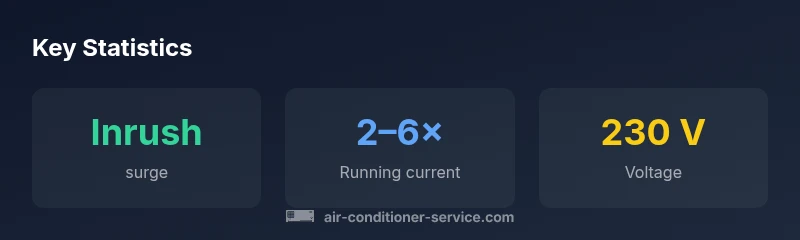
A straightforward approach is to treat the starting current as a product of running current and a multiplier that captures startup physics. The basic formula is I_start = I_running × startFactor. StartFactor reflects the motor design (single-phase vs. three-phase, capacitor-start vs. electronic-start), the presence of soft-start circuitry, and the electrical health of the system. If you know your unit’s running current from the nameplate or a measurement with a clamp meter, you can plug it into the formula with a multiplier you select based on your installation. For a 230 V system with a typical residential AC, a multiplier of 2–6 is commonly used as a heuristic, recognizing that actual inrush can be higher during very cold starts or when a unit hasn’t run for several hours. The calculator in this guide applies the same logic, returning a numeric estimate in amperes that you can compare against your breaker and conductor ratings. Remember that real-world current can deviate due to voltage drops, wire length, and circuit impedance, so always allow a safety margin.
Factors that affect inrush
- Motor type: A capacitor-start motor often exhibits higher inrush than a permanent-split capacitor (PSC) motor, especially on the first start after a long idle period.
- Start method: Soft-start electronics or variable speed drives can dramatically reduce inrush, protecting circuits.
- Voltage stability: Small voltage drops can magnify effective current during startup.
- Wiring and connections: Longer runs and undersized conductors increase impedance, which can influence peak current.
- Age and refrigerant state: A unit with aging capacitors or a refrigerant charge near the operating point may start with different inrush than a new unit.
- Temperature extremes: Cold outdoor temperatures can prompt higher initial current as lubricants and seals respond to cold conditions. This section clarifies why a single multiplier isn’t universal; it’s a guideline that should be adjusted for your equipment and installation.
Step-by-step calculation with a sample
Here is a concrete, worked example you can replicate. Suppose your air conditioner runs at 4.0 A on a 230 V circuit. You choose a startFactor of 3 based on a PSC motor with standard wiring and a steady voltage supply. The estimated starting current is I_start = 4.0 A × 3 = 12.0 A. If you plan for a 15 A circuit breaker and 12 AWG conductors, this estimate suggests a comfortable margin, but you should verify against the panel’s available capacity and the service entrance. If the same unit has an electronic soft-start, your actual inrush could be below the multiplier, potentially around 2–4 times the running current. Use a clamp meter during actual startup to confirm. This example demonstrates how to adapt the calculation to real conditions and to create a conservative plan that reduces the risk of nuisance trips.
Using the calculator to plan electrical needs
The calculator widget in this article mirrors the step-by-step method described above. Enter:
- Voltage (V): 230
- Running current (A): 4.0
- Starting multiplier: 3.0 Then run the calculation to see the estimated starting current in amperes. Use the result to check that your circuit breakers, conductors, and disconnects exceed the startup draw by a comfortable margin. For homes with older service, you may want to talk to an electrician about panel upgrades or dedicated circuits for AC units. Air Conditioner Service recommends validating all measurements with a handheld meter and comparing them to nameplate data. Safety note: never modify wiring or disconnects without turning off the main power and following local electrical codes.
Common pitfalls and misconceptions
- Using running current alone to size breakers is unsafe; starting current can differ significantly.
- Over-reliance on a single multiplier ignores device age and condition.
- Ignoring voltage sags can misestimate inrush, leading to nuisance trips.
- Assuming all units start with full capacity at every cooling cycle; seasonal cycling and stage settings affect inrush.
- Always verify estimates with actual measurements before finalizing wiring and protection schemes.
Real-world scenarios and practical takeaways
- Scenario A: A typical apartment unit on a 120/240 V split circuit with a 15 A breaker; running current around 4 A; assuming a 2.5 multiplier gives an estimated 10 A startup. This suggests acceptable margin on a 15 A breaker but still warrants measurement.
- Scenario B: A larger house unit using an electronic soft-start may show lower inrush, perhaps around 2–4× running current; planning with a conservative multiplier helps avoid trips during peak voltage dips. Air Conditioner Service emphasizes testing under real conditions and documenting measurements for future service visits.
- Takeaway: Use a simple formula, then confirm with actual measurements and keep a safety buffer to protect both equipment and occupants.