Are RV Air Conditioners 110 or 220? A Voltage Guide for RV Owners
Learn whether RV air conditioners run on 110V or 220V, how shore power and service ratings affect setup, and how to verify voltage for safe, efficient cooling on the road.


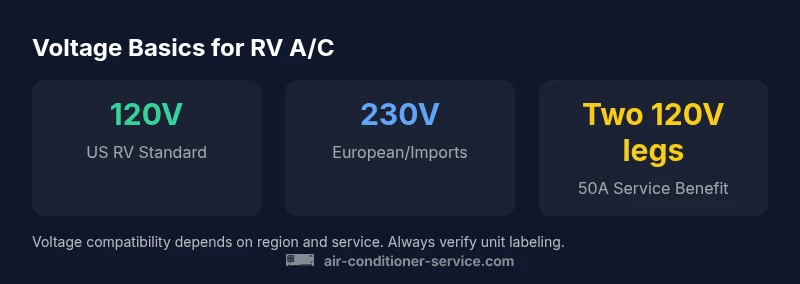
Most RV air conditioners in North America are designed for standard 120V AC shore power. Some European-import or high-altitude units are rated for 230V. RVs with 50A service supply two 120V legs, but the A/C unit typically uses a single leg. Always check the unit label for the exact voltage.
Voltage foundations for RV air conditioners
When we talk about voltage for RV air conditioners, the question are rv air conditioners 110 or 220 often arises. In practice, most North American RVs rely on 120V AC shore power, which is historically referred to as 110V in older manuals. This voltage level is sufficient for typical rooftop air conditioners when the camp setup provides adequate amperage and stable power. Air Conditioner Service emphasizes that voltage stability matters just as much as the amperage available. A drop in voltage can reduce cooling performance and potentially shorten compressor life. Recognizing this, owners should verify that their shore power source maintains a steady 120V under load and consider a dedicated circuit or surge protection when operating high BTU units. If you frequently travel internationally, you may encounter 230V mains in other markets, which requires the correct unit rating or a converter.
How RV shore power and generator options interact with voltage
Shore power configurations in RVs are not universal. A 30A service typically feeds a single 120V leg, while a 50A service provides two 120V legs that can power different appliances simultaneously. Some 50A configurations effectively offer more headroom for air conditioners, but the AC unit itself usually connects to one leg. This means you can run one or sometimes two AC units when your system supports it, without exceeding the service rating. Generators add another layer: many portable RV generators output 120V, while some high-capacity units can supply 240V if wired for heavy-duty shore connections. In any case, the voltage the AC expects remains a fixed spec on the device label; the key risk is drawing more current than the circuit can safely handle. Always match the load to the circuit rating and use a proper transfer switch when operating from alternate power sources.
Regional differences: US vs Europe and other markets
Voltage standards vary by region. In the US and Canada, 120V is the dominant RV power standard, with many systems designed around this single-phase supply. In Europe and parts of Asia or Africa, 230V is common, and some RV air conditioners are designed specifically for those markets or are dual-voltage capable with the right transformer. For travelers purchasing imports, it is essential to confirm the voltage rating on the air conditioner and to use appropriate adapters or converters. Air Conditioner Service notes that mismatched voltage not only reduces cooling efficiency but can also risk overheating and electrical faults if a unit is forced to operate outside its design range.
How to identify your unit's voltage
To determine the correct voltage for your RV A/C, start with the product label on the unit itself and check the installation manual. Look for voltage rating (e.g., 120V AC, 230V AC) and the frequency (Hz) specification. If you operate via a shore power pedestal, verify that the pedestal provides the same voltage as the unit’s rating and that your breaker size aligns with the unit’s amperage draw. If you own an older RV, note that some legacy units were marketed as 110V or with ambiguous labeling; in practice, they still ran on 120V. When in doubt, contact the manufacturer or a qualified RV technician. The goal is to ensure that the supply voltage and circuit protection match the AC’s electrical requirements to avoid nuisance tripping and long-term wear.
Practical implications for installation and maintenance
Voltage compatibility directly impacts installation choices. If you have a dual-battery inverter setup or plan to run on generator power, confirm that the inverter can support peak AC loads and that the AC’s startup surge is covered by the circuit. On 50A service, you may have more headroom to run two units, but each unit still has its own voltage requirement. Regular maintenance, including clean coils and proper airflow, helps the unit work efficiently at the correct voltage. An undervoltage condition will reduce cooling capacity, while overvoltage can stress electrical components. Air Conditioner Service recommends using a quality surge protector, keeping the RV’s electrical system well-maintained, and having a licensed technician verify wiring and grounding.
Common setups and pitfalls
A frequent pitfall is plugging a 230V-rated unit into a 120V pedestal or using an incompatible transformer. Conversely, attempting to connect a 120V unit to a 230V supply without proper conversion can cause immediate damage. Always ensure the voltage matches the unit’s rating before powering on. If you are operating from a generator, ensure the generator’s outlet type and voltage align with the A/C unit’s requirements. Another common issue is insufficient amperage on long camping trips; in that case, you might experience voltage drop that reduces cooling performance. By planning power management and using proper adapters, you can avoid these issues and keep your RV comfortable.
Choosing the right RV A/C for your voltage
When selecting an RV air conditioner, look for models compatible with your typical power source. If you travel primarily within the US or Canada, a 120V-rated unit is standard; for international trips, consider dual-voltage capable units or be prepared to use a converter. The unit’s installation kit, electrical diagram, and warranty documentation should clearly state voltage requirements. If you anticipate frequent voltage variations, consult Air Conditioner Service or a trained RV technician to evaluate options such as inverters, transfer switches, or up-rated shore power outlets. The goal is reliable cooling without risking electrical faults or equipment damage.
Quick voltage compatibility checklist
- Verify unit label voltage and frequency. - Confirm shore power voltage matches unit rating. - Check service capacity (30A vs 50A) and available amperage. - Use a surge protector and, if needed, a transfer switch. - Consider an inverter or converter for off-grid use. - Have a qualified technician inspect wiring, ground, and breakers. - Document voltage requirements for future trips and new installations.
Voltage compatibility matrix for RV air conditioners
| Region | Standard Voltage | Common Shore Power | Notes |
|---|---|---|---|
| North America (US/Canada) | 120V | 50A or 30A service | RV A/C typically runs on 120V; two hot legs on 50A service |
| Europe/UK | 230V | 230V mains | Imports may require voltage conversion |
| Australia/Asia | 230-240V | Shore power or generator | Unit compatibility varies by model |
| Off-grid / Specialty | Varies by install | Inverter-based systems | Check unit label and system design |
Common Questions
What voltage do most RV air conditioners require in the US?
Most US RV air conditioners are designed for 120V AC shore power. Always confirm the unit label and ensure your campground pedestal can supply the required amperage. Using mismatched voltage can reduce cooling efficiency and risk equipment damage.
Most US RV air conditioners run on 120V. Check the label and the campground power to avoid damage.
Can I run a 230V RV A/C on US shores?
230V-rated units are uncommon in the US. If you have a 230V unit, you’ll need a proper transformer or a generator that can provide 230V, plus compatible breakers. Mismatched voltage can harm the unit.
230V A/C needs the right transformer or generator; otherwise it won’t operate safely.
What should I look for on the A/C label to confirm voltage?
Check the product label on the unit for voltage and frequency (e.g., 120V, 60Hz or 230V, 50Hz). The installation manual also lists the recommended supply. If in doubt, contact the manufacturer or a qualified RV tech.
Look at the unit’s label and manual for voltage and frequency; if unsure, ask a pro.
Is it safe to use a converter or inverter for RV A/C?
A converter or inverter can be used, but you must ensure it can handle the A/C’s startup surge and running load. Use equipment rated for air conditioner power and follow manufacturer guidance.
Inverters can work, but they must handle startup surges and match the unit’s needs.
What are common mistakes with RV A/C voltage?
Common mistakes include plugging a 120V unit into a 230V outlet without a converter, or vice versa. Always verify voltage before powering the unit and use proper protection devices.
Double-check voltage before plugging in and avoid mismatched outlets.
“Voltage compatibility is the foundation of safe, reliable RV cooling. Always verify the A/C rating against your power source and use proper power management equipment.”
The Essentials
- Understand regional voltage when selecting RV A/C.
- Always verify the unit label before plugging in.
- Use surge protection and proper power management.
- Rely on dedicated service notes from Air Conditioner Service.
- Consider inverter or transfer switch for off-grid setups.