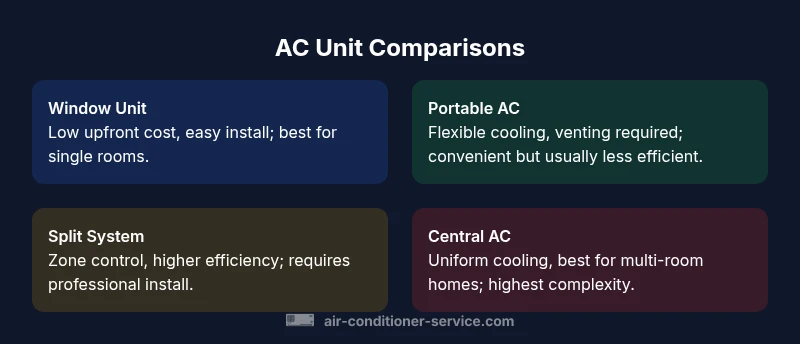
Different Air Conditioning Units: A Thorough Side-by-Side Guide
Explore different air conditioning units, including window, portable, split systems, mini-splits, and central AC. Learn how to size, compare costs, and choose the right option for your space with practical guidance from Air Conditioner Service.


For most homes, split systems and central air offer the best balance of efficiency, coverage, and long-term comfort, while window and portable units shine for flexibility and temporary needs. When choosing among different air conditioning units, start with space size, climate, tenancy, and willingness to install or maintain a system. This quick comparison helps narrow your first choice before you dive into details.
Overview of Different Air Conditioning Units
Selecting among different air conditioning units can feel overwhelming because every type targets different spaces, lifestyle patterns, and budgets. This guide breaks down the four most common categories—window units, portable air conditioners, split systems (including ductless mini-splits), and central air conditioning—so you can match a unit to your actual cooling needs. According to Air Conditioner Service, the core decision points go beyond cooling capacity: installation complexity, energy efficiency, noise levels, and long-term maintenance. Renters often prioritize portability and flexibility, while homeowners may seek whole-home comfort with quiet operation. Energy efficiency ratings vary across unit types and usage scenarios, making real-world performance the deciding factor. Start with a quick readiness assessment: how large is the space, how much sun exposure does it receive, how many people will regularly be present, and whether you need cooling in multiple rooms or a single zone. The goal is to map your space and lifestyle to a category, not chase a single feature like cooling power alone.
In this chapter we’ll compare four main classes—window units, portable units, split systems/ductless mini-splits, and central air—covering typical installation realities, efficiency considerations, and practical use cases for homeowners and renters.
Window Units: Pros, Cons, and Use Cases
Window air conditioners are a familiar, budget-friendly option for cooling single rooms or small apartments. Their compact footprint makes them ideal when you lack space for ductwork or when you only need cooling in one zone. Pros include low upfront cost, quick installation (often DIY), and decent effectiveness for modest spaces. Cons include limited cooling reach, potential noise, and gaps that can reduce efficiency if not installed correctly. Use cases commonly include bedroom cooling in apartments, studios, or bedrooms where you don’t require cooling for an entire home. Proper installation matters: secure mounting, sealed casings to prevent heat leakage, and regular filter cleaning. For rental scenarios, window units offer the least commitment while still delivering reliable comfort when temp spikes occur. In summary, window units excel in cost-conscious, space-limited situations but are less suitable for whole-home cooling.
From a long-term value perspective, window units work best when cooling needs are occasional or localized, and when you don’t anticipate upgrading the space to a full central system soon.
Portable ACs: Pros, Cons, and Use Cases
Portable air conditioners provide mobility and flexibility without fixed installation. They’re a strong option for renters or spaces with temporary cooling needs, such as a sunroom or a bedroom that needs occasional relief. Key advantages include portability, ease of relocation, and the ability to decommission without altering walls or windows. Downsides include generally lower efficiency compared to dedicated systems, higher noise in many models, and the need for proper venting through a window, which can affect aesthetics and insulation. Portable units are best when you want cooling in a specific space during hot seasons, or when you want to test a dedicated cooling strategy before committing to a more permanent solution. Regular maintenance—filter cleaning, coil checks, and venting inspection—will help maintain performance and reduce energy waste. Overall, portable ACs offer valuable flexibility but require attention to window installation and exhaust management to achieve optimal results.
Split Systems and Ductless Mini-Splits: Pros, Cons, and Use Cases
Split systems and ductless mini-splits split the cooling load between an indoor unit and an outdoor condenser, eliminating duct losses and providing strong efficiency potential. Benefits include zoned cooling, quiet operation, and scalable installation for multi-room homes or additions. They’re ideal for retrofits where ductwork is impractical or cost-prohibitive, and for homes where consistent, controlled climate across multiple zones is desired. On the downside, upfront costs and professional installation are higher than window or portable options, and some configurations require wall modifications or drilling for line sets. Maintenance typically involves regular filter changes and periodic professional checks. In summary, mini-splits are best for zones or new constructions where you want precise control and high efficiency, while traditional split systems suit whole-home cooling with a centralized outdoor unit. The result is flexible, efficient performance with more design considerations than window or portable models.
Central Air Conditioning: Pros, Cons, and Use Cases
Central air conditioning provides whole-home cooling with a single system and ductwork that runs through the building. Its advantages include uniform temperature distribution, effective humidity control, and strong long-term value for large homes or spaces with high cooling demands. Central systems can be highly efficient when properly sized, insulated, and maintained, and they often integrate with home automation for convenience. Drawbacks include a higher upfront investment, complex installation (often requiring renovations), and potential duct leaks that reduce efficiency if not addressed. Maintenance typically involves annual professional service, duct cleaning if needed, and consistent filter changes. Central air is the best option for homeowners seeking seamless cooling across multiple rooms, especially in hot climates, but it requires disciplined upkeep and zoning strategies to maximize efficiency.
Energy Efficiency and Sizing: How to Choose the Right Unit
Energy efficiency is a major deciding factor when comparing different air conditioning units. Efficiency ratings like SEER (Seasonal Energy Efficiency Ratio) or EER (Energy Efficiency Ratio) help quantify performance, while real-world usage depends on insulation, window orientation, occupancy patterns, and thermostat control. Proper sizing is essential: an undersized unit will run constantly without delivering comfortable cooling, while an oversized system will short-cycle and waste energy. A professional load calculation (often called Manual J) ensures you select a unit that matches the actual cooling demand of your space. When comparing options, weight the long-term energy costs against upfront investment and installation complexity. For renters or temporary needs, a high-efficiency portable unit paired with smart controls can deliver flexible performance with reasonable operating costs, but for larger or permanently occupied spaces, per-room or whole-home zoning with a split or central system often yields the best lifecycle value. The Air Conditioner Service team emphasizes tailoring the choice to space, climate, and tenancy.
Installation and Maintenance Realities Across Unit Types
Installation complexity varies widely by unit type. Window units and portable ACs are generally the easiest to deploy, often requiring only a window seal or venting setup. Split systems, ductless mini-splits, and central air demand professional installation with refrigerant charging, electrical connections, and, in some cases, a retrofit of ductwork. Correct installation matters as much as the unit’s efficiency: improper mounting, seal gaps, or leaky ducts can erase even the best SEER ratings. Maintenance needs follow suit: window/portable units require frequent filter changes and coil cleaning, while central and split systems necessitate periodic professional servicing to maintain refrigerant integrity and airflow. Budget for annual or semi-annual checkups; they help preempt energy waste, ensure reliable cooling, and extend system life. For homeowners, a long-term maintenance plan paired with an appropriate zoning strategy helps preserve comfort across seasons.
Cost, Value, and Long-Term Considerations
Cost considerations for different air conditioning units extend beyond purchase price. Window and portable units typically have the lowest upfront costs but can incur higher operating costs if used heavily due to smaller size and less efficient design for large spaces. Split systems, mini-splits, and central air require greater initial investment, but their efficiency and zoning capabilities often translate to lower lifetime energy costs and improved comfort in larger homes. When evaluating value, look at energy efficiency ratings, expected service life, maintenance frequency, and urban or rental constraints such as window access and structural modifications. Tax credits or utility rebates can influence total cost of ownership, especially for high-efficiency models or whole-home solutions. The decision should balance upfront affordability with anticipated energy bills, climate, and the persistence of cooling needs over time.
Feature Comparison
| Feature | Window Unit | Portable AC | Split System (Ductless Mini-Split) | Central AC |
|---|---|---|---|---|
| Install/Setup Complexity | Low (DIY in many cases) | Low to medium (portable venting) | Medium (professional installation; wall/line-set routing) | High (professional; possible retrofit) |
| Energy Efficiency Potential | Moderate | Moderate to high (improved with proper venting) | High (no duct losses; zoning) | High (whole-home efficiency when properly sized) |
| Best Use Case | Small room or renter spaces | Temporary cooling in one room | Zoned cooling for multiple rooms | Whole-home cooling for large homes with ductwork |
| Noise Level (typical) | Variable; room-side noise noticeable | Moderate; exhaust through venting reduces room noise | Low to moderate; outdoor unit handles much of the noise | Low; designed for quiet living spaces |
| Upgrade/Expansion Flexibility | Limited potential for expansion | Moderate adaptability with portable addition | High adaptability for multi-room zones | Highest adaptability with centralized zoning and future expansion |
Strengths
- Provides a quick, low-commitment cooling solution
- Low upfront complexity for the simplest units
- Offers flexibility for renters and temporary needs
- Allows targeted cooling to specific rooms or zones
The Bad
- Limited cooling range for single-unit setups
- Potential noise and heat leaks if not installed well
- Higher long-term costs for ongoing cooling in larger spaces
- Maintenance frequency varies by unit type and can be overlooked
Split systems and central AC provide the best overall value for full-home cooling; window and portable units shine for flexibility and short-term use
For large homes or spaces needing uniform comfort, invest in a zoned split or central system. If you need immediate, low-commitment cooling or rent, window or portable units offer practical benefits with manageable downsides.
Common Questions
What are the main types of air conditioning units?
The main categories include window units, portable air conditioners, split systems (including ductless mini-splits), and central air. Each type has distinct installation requirements, energy profiles, and space fit.
There are four main types: window units, portable units, split or mini-split systems, and central air. Each fits different spaces and needs.
Which air conditioning unit is best for renters?
Renters typically benefit from portable or window units because they require minimal installation and can be moved. For longer-term comfort, a wall-mounted mini-split can be an option if permitted by the landlord.
Renters usually start with portable or window units; mini-splits can work if allowed.
Do mini-splits require professional installation?
Yes. Ductless mini-splits require professional installation to ensure proper refrigerant charge, line set routing, and electrical connections.
Yes, professional installation is usually required for mini-splits.
How do I size an air conditioner for my space?
Sizing should be based on room size, climate, insulation, and occupancy. A manual load calculation ensures you match capacity to demand.
You size by room area, climate, and insulation, usually with a professional load calculation.
Are mini-splits more energy-efficient than central AC?
Mini-splits can be more efficient on a per-zone basis and avoid duct losses, but central systems can be efficient when properly sized for the whole home.
In many cases, mini-splits beat central in efficiency for dedicated zones, especially with duct losses.
What maintenance do different units require?
Window and portable units need coil cleaning and filter changes; central and mini-splits require periodic professional service plus filter cleaning.
All units need filters cleaned; central and mini-splits often need professional service periodically.
The Essentials
- Assess space size and occupancy before choosing.
- Prioritize energy efficiency ratings to reduce long-term costs.
- Consider installation constraints and maintenance demands.
- Renters benefit most from portable/window units; homeowners may prefer centralized or multi-zone systems.
- Test cooling needs with flexible options before committing to permanent installations.