Which air con unit: A Practical, Data‑Driven Comparison for Homeowners
A vendor-neutral, data-driven guide to selecting the right air conditioner for homes and apartments. Compare window, portable, split-system, and central units, with installation, energy use, and maintenance considerations to choose which air con unit fits your space and budget.


Which air con unit should you buy? For most homes, a ductless mini-split or window unit offers the best balance of cooling efficiency, cost, and installation ease. If you have a larger space or existing ductwork, central or packaged systems may provide lower lifecycle costs. This guide compares options, installation needs, and energy use to help you decide which air con unit fits your needs.
Why the question "which air con unit" matters
Choosing which air con unit to install is more than picking a gadget. It shapes energy bills, comfort, and long-term maintenance. Homeowners and renters alike want reliable cooling without waste, and the right choice depends on space, climate, and how you live in the home. This section frames the problem and anchors the discussion in practical decision criteria. According to Air Conditioner Service, households that start with a clear space assessment tend to select more effective cooling systems and see better performance over time. The phrase "which air con unit" recurs as we balance up-front costs with ongoing energy savings, and we ground every recommendation in real-world guidelines that any homeowner can apply today.
Core types of air con units
There are four main families of air conditioning systems that commonly answer the question of which air con unit is best for a given home:
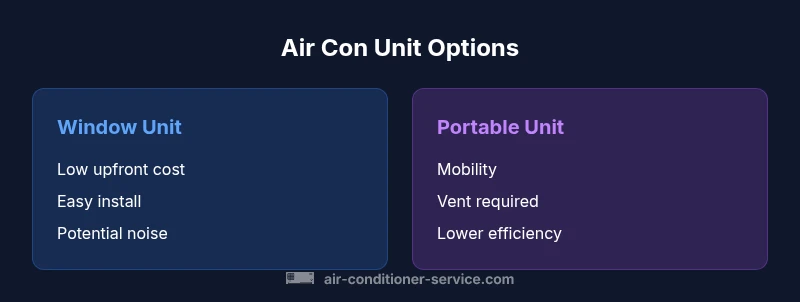
- Window units: inexpensive, compact, and quick to install. Great for small rooms or retrofit in a rented space. Watch for noise, airflow limits, and blocking of the window. In many cases a window unit is the fastest path to cooling a single room while you evaluate longer-term options.
- Portable units: mobile and easy to move between rooms. They require no fixed installation, but they tend to be less energy-efficient and bulkier than fixed solutions. They are often a stopgap measure for temporary needs or renters awaiting a longer-term plan.
- Split-system (ductless) units: a compact outdoor condenser paired with one or more interior air-handlers. They offer high efficiency, precise zoning, and minimal ductwork. These systems are a popular choice when you want to tailor cooling without a full ducted network, and they excel in spaces where installing ducts would be disruptive.
- Central AC: a whole-house solution with a single outdoor unit and a network of ducts. It provides uniform comfort, makes sense for larger homes, and can deliver strong resale value. The upfront cost and installation complexity are higher, and duct maintenance becomes part of ownership.
In practice, the best pick for which air con unit depends on your room count, lifestyle, and the long-term ownership perspective. In the sections that follow, we’ll compare typical use cases, costs, and performance metrics to help you make an informed decision.
How to assess your space before choosing
Before deciding which air con unit to install, perform a structured space assessment. Measure room dimensions and list floor plan characteristics. Note sun exposure, ceiling height, and occupancy patterns that influence load. Consider window orientation and whether you can accommodate external units or ductwork. For renters, verify landlord permission and assess whether a portable or window unit can meet the cooling needs without compromising flexibility. The goal is to translate physical space into a cooling load estimate and an installation plan that minimizes energy waste. This practical approach makes the next steps concrete and helps answer which air con unit is most appropriate for your home.
Efficiency and energy labels explained
Understanding efficiency is essential when deciding which air con unit to buy. Most systems carry some form of seasonal energy performance rating or label. In general, higher efficiency models deliver more cooling per kilowatt-hour, reducing operating costs over time. For ductless mini-splits and central systems, inverter-driven compressors often offer better efficiency and quieter operation. For renters or tight budgets, a high-efficiency window unit or a portable model may still provide solid efficiency with lower upfront costs. When evaluating options, compare SEER (seasonal energy efficiency ratio) or EER (energy efficiency ratio) metrics, and look for Energy Star-rated models where relevant. The key is to balance upfront price against expected yearly energy use—especially in climates with long cooling seasons. This thoughtful approach helps answer which air con unit makes the most sense for your climate.
Installation considerations that affect choice
Installation complexity can drive the overall value of the selected air con unit. Window units demand a secure mounting and may require weatherproof sealing. Portable units are easiest to deploy but still need a proper vent hose and stable surface. Split-system installations require mounting indoor air handlers, routing refrigerant lines, and setting up the outdoor condenser; these steps demand professional expertise to ensure correct refrigerant charge and performance. Central AC involves ductwork, electrical upgrades, and often outdoor pad preparation. Beyond cost, installation affects comfort: improper sizing or poor duct sealing leads to uneven cooling and higher energy use. When you’re weighing which air con unit to install, consider not only current needs but the feasibility of future room rearrangements or expansions.
Budget and lifecycle costs
Total cost goes beyond the sticker price. Window and portable units typically demand lower upfront costs but may incur higher long-term operating expenses if you rely on them heavily. Split systems require a larger initial investment but offer excellent long-term efficiency, which can translate into lower lifetime costs. Central AC, while the most expensive to install, can deliver uniform cooling with strong efficiency in large homes. In all cases, factor in maintenance, potential duct cleaning or filter replacements, and the cost of seasonal service. When evaluating which air con unit to choose, consider not just purchase price but the long-term energy and service costs that accumulate over 5–15 years.
Noise, comfort, and climate control
Noise levels and zoning capabilities matter for genuine comfort. Window units can be noisier and may deliver uneven cooling if not properly installed. Portable units vary in noise and efficiency. Split-system mini-splits excel for quiet operation and precise zoning, letting you cool only occupied spaces. Central AC provides uniform comfort, but the acoustics depend on duct design and indoor grille placement. When selecting which air con unit to buy, also think about how you’ll use the space: bedrooms for night-time cooling, home offices for daytime HVAC, or living areas for communal comfort. A well-chosen unit reduces the tradeoffs between temperature, humidity, and noise.
Which air con unit for apartments, homes, or rentals?
For apartments, a window unit or a ductless mini-split is often the most practical choice, balancing cost, speed, and control. Renters may prefer portable units for flexibility and a lighter footprint, provided building rules permit them. For single-room homes or studios, a compact window or mini-split can deliver efficient cooling without a full duct system. For larger homes with multiple zones, a zoned mini-split or central system becomes more cost-effective and comfortable over time, even though the upfront investment is higher. The core rule when deciding which air con unit to install is to match capacity to load, footprint to budget, and future plans to lifestyle expectations.
Climate and local regulations that affect your choice
Regional climate patterns influence the sizing and efficiency of the air con unit you choose. In hot, humid regions, high-efficiency models with reliable humidity control deliver the most comfort. Colder or milder climates may favor smaller, cost-efficient units. Some jurisdictions offer rebates or incentives for energy-efficient installations, particularly for central or high-efficiency split systems. Always check local regulations about outdoor equipment, noise limits, and permit requirements. Understanding these factors helps you answer which air con unit will perform best in your area while staying compliant and cost-effective.
Maintenance and longevity
All air con units benefit from regular maintenance, including filter cleaning, coil brushing, and seasonal inspection. Split and central systems rely on sealed refrigerant circuits and may require professional service to maintain efficiency and refrigerant charge. Window and portable units need periodic cleaning and vent hose management. Longevity depends on usage patterns, climate, and maintenance quality. A well-maintained unit tends to perform more reliably and avoids energy waste from dirty coils or clogged filters. If you’re committed to preserving performance, plan for annual checkups and routine cleaning as part of the ownership experience for the chosen air con unit.
Quick-start checklist for choosing
- Define cooling needs by room and climate. 2) Assess installation feasibility (windows, walls, ducts, electrical capacity). 3) Compare efficiency ratings and expected operating costs. 4) Estimate total 5- to 10-year costs including maintenance. 5) Check warranty terms and service availability in your area. 6) Decide on a preferred option (window, portable, split-system, or central) and schedule a professional assessment if needed. This practical checklist helps you start with the question which air con unit and end with a confident buy.
Final decision framework
The best answer to which air con unit you should choose is context dependent. For rentals and small spaces, window or portable units offer speed and flexibility. For energy-conscious households with multiple rooms, a zoned split-system or central AC can deliver better comfort and lifecycle cost. The final decision should balance upfront price, installed cost, energy efficiency, noise, and the ability to adapt to future space changes. Use this framework to compare options against your space, climate, and budget, then validate with a professional assessment if needed.
Feature Comparison
| Feature | Window Unit | Portable Unit | Split-system (Ductless) | Central AC |
|---|---|---|---|---|
| Typical cooling capacity (BTU) | 5,000–14,000 BTU | 8,000–14,000 BTU | 9,000–36,000 BTU per zone | 18,000–60,000 BTU whole house |
| Installation complexity | Low: mount in window | Low to moderate: no permanent installation | Moderate to high: indoor unit plus outdoor condenser | High: ductwork, electrical, outdoor unit |
| Energy efficiency (typical) | Moderate to high, varies by model | Moderate, portable design | High (inverter models common) | High-to-moderate depending on SEER |
| Upfront cost range | $100–$800 | $150–$1,000 | $1,000–$3,000 | $3,000–$8,000+ |
| Best for | Small rooms or renters | Temporary cooling, flexible placement | Zoned cooling, energy efficiency | Whole-house comfort and resale value |
Strengths
- Clear, decision-focused framework for choosing between common options
- Realistic, budget-conscious guidance with installation notes
- Balanced view of energy efficiency and long-term costs
- Good for homeowners and renters needing practical steps
- Supports a structured comparison across formats
The Bad
- Broad guidance may still require professional sizing for complex homes
- Not every climate or occupancy pattern fits every option
- Some installation scenarios require permits or contractor involvement
Split-system (ductless) often offers the best balance of efficiency and flexibility for many homes; central AC excels in larger houses, while window/portable options suit renters and small spaces.
Choose a ductless split for multi-room control; central for whole-home use; window/portable for budget and quick deployment. The best pick depends on space, climate, and long-term ownership goals.
Common Questions
Which air con unit is best for a renter?
For renters, window units or portable options offer fast, low-commitment cooling with minimal changes to existing spaces. If allowed, a ductless mini-split provides better efficiency and zoning for longer stays. Always check with the landlord about restrictions before purchasing.
Renters usually prefer window or portable units for flexibility. If allowed, a mini-split delivers better efficiency and zone control.
How do I size an air con unit for a room?
Start with the room square footage and ceiling height to estimate BTU needs. Adjust for sun exposure, insulation, and occupant load. A professional or reputable sizing chart can refine the estimate to prevent under- or over-cooling.
Measure the room and use BTU guidelines to pick a unit; factor in sun and insulation for accuracy.
Are energy-efficient models worth the extra cost?
In hot climates with long cooling seasons, higher efficiency typically saves more on energy bills over time. In milder climates, the payoff may be slower. Weigh initial premium against projected yearly savings and warranty terms.
Yes, often worth it in warm climates with long cooling seasons, but assess your local use pattern.
Do I need professional installation for every unit?
Central AC and ductless splits generally require professional installation to ensure correct sizing and refrigerant handling. Window and portable units can be installed by most homeowners, though a professional check can improve performance and safety.
Central and ductless systems usually need pros; window units can be DIY with care.
How often should I service my air con unit?
Most systems benefit from at least annual professional service, with monthly filter checks by the user. Regular maintenance prevents efficiency losses and extends system life.
Annual professional service plus monthly filter checks keeps performance high.
Can I install a ductless mini-split myself?
DIY installation is possible but risky due to refrigerant handling and electrical connections. A licensed technician ensures proper charge, safety, and warranty validity.
We recommend professional installation for ductless minis due to safety and warranty concerns.
The Essentials
- Assess space and climate before choosing.
- Consider energy efficiency as a long-term cost factor.
- Weigh installation effort against long-term comfort.
- Renters benefit from portable or window units.
- Plan for maintenance to maximize efficiency