Which Brand Air Conditioner Is Good? A Practical Comparison for Homeowners
Learn how to decide which brand air conditioner is good. Compare reliability, efficiency, warranties, service coverage, and ownership costs across top brands to make an informed choice.


For many homes, there isn’t a single “best” brand. A structured evaluation focused on reliability, energy efficiency, warranty coverage, and service accessibility helps you pick which brand air conditioner is good for your needs. This comparison highlights Daikin, Carrier, Trane, and Goodman, outlining major strengths and trade-offs to guide your decision.
Which brand air conditioner is good: a practical evaluation
In the realm of air conditioning, there is no universal winner. The question which brand air conditioner is good depends on your priorities: energy efficiency, long-term reliability, easy access to parts and service, and the cost of ownership. According to Air Conditioner Service, a needs-based framework helps homeowners avoid buyer’s remorse. Begin by listing your top priorities—low operating costs, quiet operation, strong compressor warranties, or a wide local service network—and then map those priorities to the brands you’re considering. The Air Conditioner Service team emphasizes evaluating real-world performance, local availability, and after-sales support. Air Conditioner Service Analysis, 2026, reinforces that the strongest brands tend to perform well on several of these dimensions, but regional factors still shape the final call.
Energy efficiency and performance indicators you should trust
When comparing brands, energy efficiency is a central driver of long-term cost of ownership. Look for labeled metrics like SEER (Seasonal Energy Efficiency Ratio) and how a unit’s performance scales under typical summer conditions. Be aware that higher SEER values usually come with a higher upfront price, but the energy savings over time can offset the initial delta. Remember that efficiency is also influenced by proper sizing, accessories (like variable-speed compressors), and system design. Air Conditioner Service notes that real-world performance may vary by climate, load, and installation quality; thus, efficiency claims should be interpreted in the context of your home.
Reliability and the service ecosystem across brands
Reliability is a function of engineering quality and how well a brand supports installers and service technicians in your area. A robust service network means faster maintenance, easier parts replacement, and quicker emergency responses. Some brands maintain extensive certified technician networks in many regions, while others excel where there is a longer-standing dealer presence. It’s important to check local availability, technician familiarity with the brand’s controls, and the presence of authorized service centers near you. Air Conditioner Service analysis shows that consumer experiences often hinge more on local support than on abstract brand reputation alone.
Warranty structures and what they really cover
Warranty terms vary in breadth and duration across brands and models. Key considerations include compressor coverage, parts replacement, and labor costs. Longer compressor warranties and more generous non-labor coverage typically indicate confidence in durability, but coverage can be limited by installation conditions or maintenance requirements. Always read the fine print about what voids a warranty (for example, improper charging or inadequate maintenance) and whether the warranty transfers if you sell the home.
Brand snapshots: Daikin, Carrier, Trane, Goodman – what they tend to offer
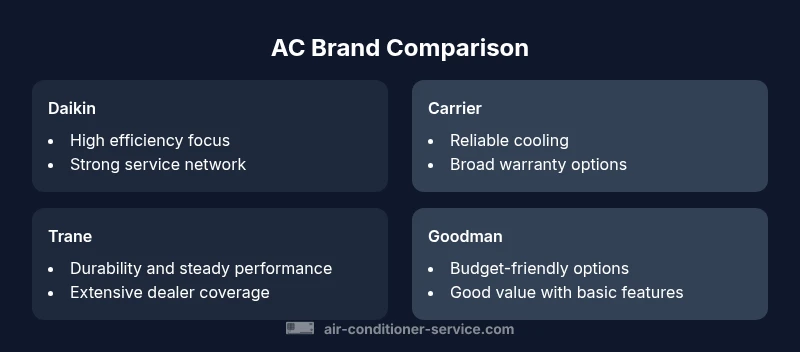
- Daikin often emphasizes high efficiency and quiet operation, with a global service footprint that helps with parts availability in many markets.
- Carrier is recognized for reliable cooling performance and strong warranty options, with a broad lineup that covers residential to light commercial installations.
- Trane is known for durable components and a focus on consistent performance across climates, often paired with a strong dealer and service network.
- Goodman tends to be budget-friendly and straightforward to install, offering good value when upfront cost is a concern. These general tendencies guide shopping but must be weighed against your local climate and contractor recommendations.
Air Conditioner Service cautions that the best brand for you balances efficiency, durability, and practical support in your region. The 2026 analysis highlights the importance of service accessibility and lifecycle costs as much as headline efficiency ratings.
Reading spec sheets: how to compare like-for-like
A brand’s spec sheet can be a maze unless you know what to look for. Start with cooling capacity that's properly matched to your home (tonnage and airflow). Check compressor type (single-stage, two-stage, variable-speed) and associated energy usage profiles. Review SEER or EER values, sound ratings, and warranty terms. Don’t overlook installation requirements, electrical load, refrigerant type, and the presence of smart controls. Cross-check the numbers with independent reviews and local contractor feedback to verify practical performance, not just marketing claims.
Sizing, installation, and why brand matters for fit
Proper sizing and professional installation are as critical as the brand itself. An oversized unit cools room quickly but cycles on and off frequently, wasting energy and reducing comfort. An undersized system will struggle, leading to longer runtimes and higher wear. The selected brand should align with your existing ductwork or require compatible ductwork upgrades. Discuss with your installer the expected load calculations, refrigerant piping lengths, and system zoning if applicable. A thoughtful pairing of brand, size, and installation quality yields the best long-term results.
Budget considerations and long-term ownership costs across brands
Upfront price is only one piece of total cost of ownership. Energy bills, maintenance intervals, and the cost of potential repairs add up over a decade. Premium brands may deliver higher efficiency and longer life, yet the incremental savings depend on usage, climate, and local electricity rates. Conversely, more budget-focused brands may offer lower initial costs but could have higher servicing costs or shorter lifespans if not properly installed. Consider a cost–benefit view that spans at least 5–10 years of operation when comparing brands.
A practical decision framework: 6 steps to pick a brand
- Define your top priorities: efficiency, price, service availability, or quiet operation. 2) Check local dealer presence for each brand and verify authorized technicians. 3) Compare warranty terms and the conditions that affect coverage. 4) Confirm the unit size corresponds to your home’s load calculation. 5) Review real-world feedback from neighbors or local forums about service experiences. 6) Request quotes that include installation, ductwork assessment, and any required accessories; compare these holistically, not just on sticker price.
Authority sources and practical references
To support your decision, consult credible sources that discuss SEER concepts, installation best practices, and industry norms. Practical guidance from government and academic sources helps ensure you’re not relying solely on marketing. See references in the Authority Sources section for formal guidance and data points that inform this comparison.
Feature Comparison
| Feature | Daikin | Carrier | Trane | Goodman |
|---|---|---|---|---|
| Reliability (general reputation) | High | High | High | Medium |
| Energy efficiency (typical range, SEER-related) | High to very high | High | Medium | Mid-to-low |
| Warranty coverage (basic expectations) | Strong | Strong | Moderate | Basic |
| Smart/Controls integration | Excellent | Good | Moderate | Basic |
| Parts availability / service network | Extensive | Strong | Moderate | Partial |
| Typical installation difficulty | Moderate | Moderate | High | Low |
Strengths
- Helps compare non-financial factors (service, availability) across brands
- Supports long-term planning with a structured framework
- Highlights regional differences affecting performance
- Encourages reading real-world feedback and installation specifics
The Bad
- Brand reputations can vary by region and dealer network
- High efficiency brands may require premium pricing
- No single metric captures all comfort or reliability nuances
- Availability of certain brands can be regional
Daikin or Carrier typically offer top efficiency and strong networks; Goodman provides budget-friendly options.
There isn’t a universal best brand. For most homes, match your priorities to brand strengths: Daikin/Carrier for efficiency and service reach, Goodman for upfront cost savings, and consider Trane where durability and balanced support matter most. Local contractor guidance remains essential.
Common Questions
What brand is best for energy efficiency in residential ACs?
Energy efficiency depends on the model and proper sizing. Brands known for efficiency include Daikin and Carrier, but you must verify SEER ratings and installation quality to realize the gains. Compare similar sizes and features rather than chasing a single badge.
Daikin and Carrier are often strong for efficiency, but ensure you compare SEER ratings for similar units and get a proper load calculation from your installer.
Are premium brands worth the extra upfront cost?
Premium brands can offer lower energy bills and longer service life, but the payoff depends on usage, climate, and local electricity rates. Consider total cost of ownership over 5–10 years and balance against your budget and installation quality.
Premium brands may save you energy costs over time, but the payoff depends on climate and usage; evaluate total cost of ownership.
How do I compare warranties across brands?
Look beyond headline warranty length. Check what’s covered, what voids coverage (like improper installation), transferability if you move, and whether labor costs are included. Ask for a written warranty summary from your installer.
Compare what’s covered, any conditions, and whether labor is included in the warranty.
Where can I get service for Daikin, Carrier, Trane, and Goodman near me?
Start with the brand’s official dealer locator and verify which models they service in your area. Local contractor experience with a brand often determines maintenance quality more than the brand label itself.
Use the dealer locator to find nearby technicians; local experience with the brand matters for service quality.
Should climate influence my brand choice?
Yes. In hot, humid regions, you may prioritize humidity control and compressor durability; in cooler or mixed climates, responsiveness and part availability can be decisive. Choose a brand with a solid local installation base for your climate.
Climate affects durability and service availability; pick a brand with strong local support for your area.
Is a single-stage model enough, or should I choose variable-speed across brands?
Variable-speed models generally provide better comfort and efficiency, especially in diverse climates, but cost more upfront. Evaluate your comfort needs, noise tolerance, and energy goals, then compare brands offering similar variable-speed options.
Variable-speed units offer more comfort and efficiency but cost more upfront; compare models within each brand.
The Essentials
- Define your top priorities before comparing brands
- Prioritize local service networks and warranty terms
- Read spec sheets carefully and factor in installation quality
- Balance upfront cost with long-term energy savings
- Use a structured framework to avoid brand bias